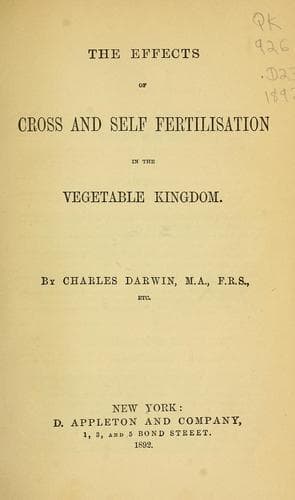
The Effects of Cross & Self-Fertilisation in the Vegetable KingdomDarwin, Charles
Science
The Effects of Cross & Self-Fertilisation in the Vegetable Kingdom
Darwin, Charles
Fertilization of plants; Plants -- Variation; Pollination
Twenty crossed plants raised from the seeds of perfect flowers were to
twenty self-fertilised plants, likewise raised from the seeds of perfect
flowers, in height as 100 to 99. The experiment was repeated, with the
sole difference that the plants were allowed to grow more crowded; and
now the twenty-four tallest of the crossed plants were to the
twenty-four tallest self-fertilised plants in height as 100 to 94, and
in weight as 100 to 97. Moreover, a larger number of the crossed than of
the self-fertilised plants grew to a moderate height. The
above-mentioned twenty crossed plants were also grown in competition
with twenty self-fertilised plants raised from the closed or cleistogene
flowers, and their heights were as 100 to 94. Therefore had it not been
for the first trial, in which the crossed plants were to the
self-fertilised in height only as 100 to 99, this species might have
been classed with those in which the crossed plants exceed the
self-fertilised by above five per cent. On the other hand, the crossed
plants in the second trial bore fewer capsules; and these contained
fewer seeds, than did the self-fertilised plants, all the capsules
having been produced by cleistogene flowers. The whole case therefore
must be left doubtful.
19. Pisum sativum (common pea).
Four-plants derived from a cross between individuals of the same variety
were in height to four self-fertilised plants belonging to the same
variety as 100 to 115. Although this cross did no good, we have seen
under Table 7/C that a cross between distinct varieties adds greatly to
the height and vigour of the offspring; and it was there explained that
the fact of a cross between the individuals of the same variety not
being beneficial, is almost certainly due to their having been
self-fertilised for many generations, and in each generation grown under
nearly similar conditions.
20, 21, 22. Canna warscewiczi.
Plants belonging to three generations were observed, and in all of three
the crossed were approximately equal to the self-fertilised; the average
height of the thirty-four crossed plants being to that of the same
number of self-fertilised plants as 100 to 101. Therefore the crossed
plants had no advantage over the self-fertilised; and it is probable
that the same explanation here holds good as in the case of Pisum
sativum; for the flowers of this Canna are perfectly self-fertile, and
were never seen to be visited by insects in the hothouse, so as to be
crossed by them. This plant, moreover, has been cultivated under glass
for several generations in pots, and therefore under nearly uniform
conditions. The capsules produced by the cross-fertilised flowers on the
above thirty-four crossed plants contained more seeds than did the
capsules produced by the self-fertilised flowers on the self-fertilised
plants, in the proportion of 100 to 85; so that in this respect crossing
was beneficial.
23. Primula sinensis.
Public-domain text, read in full here on John Shaqi.
Reviews
Reviews
No reviews yet
Be the first to share your thoughts on this work.
Elsewhere in the archive
Join the Discussion
Join the discussion
Sign in to leave a comment or review.
Sign InorCreate an account