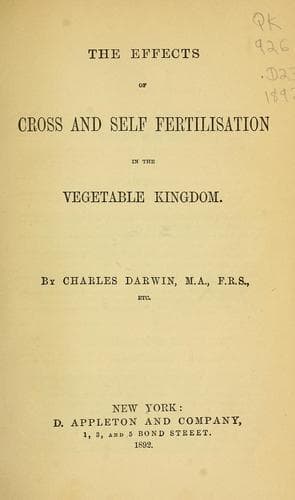
The Effects of Cross & Self-Fertilisation in the Vegetable KingdomDarwin, Charles
Science
The Effects of Cross & Self-Fertilisation in the Vegetable Kingdom
Darwin, Charles
Fertilization of plants; Plants -- Variation; Pollination
The offspring of plants, some of which were legitimately and others
illegitimately fertilised with pollen from a distinct plant, were almost
exactly of the same height as the offspring of self-fertilised plants;
but the former with rare exceptions flowered before the latter. I have
shown in my paper on dimorphic plants that this species is commonly
raised in England from self-fertilised seed, and the plants from having
been cultivated in pots have been subjected to nearly uniform
conditions. Moreover, many of them are now varying and changing their
character, so as to become in a greater or less degree equal-styled, and
in consequence highly self-fertile. Therefore I believe that the cause
of the crossed plants not exceeding in height the self-fertilised is the
same as in the two previous cases of Pisum sativum and Canna.
24, 25, 26. Nicotiana tabacum.
Four sets of measurements were made; in one, the self-fertilised plants
greatly exceeded in height the crossed, in two others they were
approximately equal to the crossed, and in the fourth were beaten by
them; but this latter case does not here concern us. The individual
plants differ in constitution, so that the descendants of some profit by
their parents having been intercrossed, whilst others do not. Taking all
three generations together, the twenty-seven crossed plants were in
height to the twenty-seven self-fertilised plants as 100 to 96. This
excess of height in the crossed plants, is so small compared with that
displayed by the offspring from the same mother-plants when crossed by a
slightly different variety, that we may suspect (as explained under
Table 7/C) that most of the individuals belonging to the variety which
served as the mother-plants in my experiments, had acquired a nearly
similar constitution, so as not to profit by being mutually
intercrossed.]
Reviewing these twenty-six cases, in which the crossed plants either do
not exceed the self-fertilised by above five per cent in height, or are
inferior to them, we may conclude that much the greater number of the
cases do not form real exceptions to the rule,--that a cross between two
plants, unless these have been self-fertilised and exposed to nearly the
same conditions for many generations, gives a great advantage of some
kind to the offspring. Of the twenty-six cases, at least two, namely,
those of Adonis and Bartonia, may be wholly excluded, as the trials were
worthless from the extreme unhealthiness of the plants. Inn twelve other
cases (three trials with Eschscholtzia here included) the crossed plants
either were superior in height to the self-fertilised in all the other
generations excepting the one in question, or they showed their
superiority in some different manner, as in weight, fertility, or in
flowering first; or again, the cross-fertilised flowers on the
mother-plant were much more productive of seed than the self-fertilised.
Public-domain text, read in full here on John Shaqi.
Reviews
Reviews
No reviews yet
Be the first to share your thoughts on this work.
Elsewhere in the archive
Join the Discussion
Join the discussion
Sign in to leave a comment or review.
Sign InorCreate an account