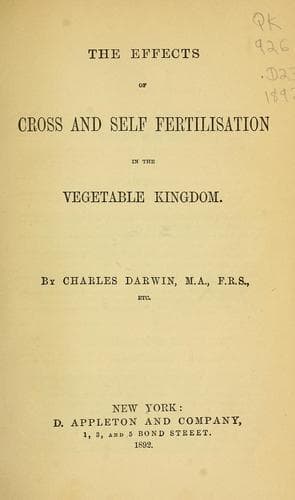
The Effects of Cross & Self-Fertilisation in the Vegetable KingdomDarwin, Charles
Science
The Effects of Cross & Self-Fertilisation in the Vegetable Kingdom
Darwin, Charles
Fertilization of plants; Plants -- Variation; Pollination
Sometimes crossed and self-fertilised seeds were sown in separate rows
in the open ground, which was kept clear of weeds; so that the seedlings
were not subjected to any competition with other kinds of plants. Those
however in each row had to struggle with the adjoining ones in the same
row. When fully grown, several of the tallest plants in each row were
selected, measured, and compared. The result was in several cases (but
not so invariably as might have been expected) that the crossed plants
did not exceed in height the self-fertilised in nearly so great a degree
as when grown in pairs in the pots. Thus with the plants of Digitalis,
which competed together in pots, the crossed were to the self-fertilised
in height as 100 to 70; whilst those which were grown separately were
only as 100 to 85. Nearly the same result was observed with Brassica.
With Nicotiana the crossed were to the self-fertilised plants in height,
when grown extremely crowded together in pots, as 100 to 54; when grown
much less crowded in pots as 100 to 66, and when grow in the open
ground, so as to be subjected to but little competition, as 100 to 72.
On the other hand with Zea, there was a greater difference in height
between the crossed and self-fertilised plants growing out of doors,
than between the pairs which grew in pots in the hothouse; but this may
be attributed to the self-fertilised plants being more tender, so that
they suffered more than the crossed, when both lots were exposed to a
cold and wet summer. Lastly, with one out of two series of Reseda
odorata, grown out of doors in rows, as well as with Beta vulgaris, the
crossed plants did not at all exceed the self-fertilised in height, or
exceeded them by a mere trifle.
The innate power of the crossed plants to resist unfavourable conditions
far better than did the self-fertilised plants, was shown on two
occasions in a curious manner, namely, with Iberis and in the third
generation of Petunia, by the great superiority in height of the crossed
over the self-fertilised seedlings, when both sets were grown under
extremely unfavourable conditions; whereas owing to special
circumstances exactly the reverse occurred with the plants raised from
the same seeds and grown in pairs in pots. A nearly analogous case was
observed on two other occasions with plants of the first generation of
Nicotiana.
Public-domain text, read in full here on John Shaqi.
Reviews
Reviews
No reviews yet
Be the first to share your thoughts on this work.
Elsewhere in the archive
Join the Discussion
Join the discussion
Sign in to leave a comment or review.
Sign InorCreate an account