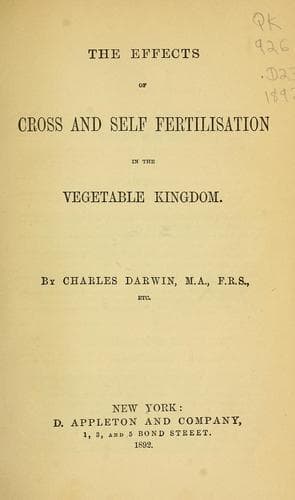
The Effects of Cross & Self-Fertilisation in the Vegetable KingdomDarwin, Charles
Science
The Effects of Cross & Self-Fertilisation in the Vegetable Kingdom
Darwin, Charles
Fertilization of plants; Plants -- Variation; Pollination
My usual method of proceeding, namely, to plant several pairs of crossed
and self-fertilised seeds in an equal state of germination on the
opposite sides of the same pots, so that the plants were subjected to
moderately severe mutual competition, was I think the best that could
have been followed, and was a fair test of what occurs in a state of
nature. For plants sown by nature generally come up crowded, and are
almost always exposed to very severe competition with one another and
with other kinds of plants. This latter consideration led me to make
some trials, chiefly but not exclusively with Ipomoea and Mimulus, by
sowing crossed and self-fertilised seeds on the opposite sides of large
pots in which other plants had long been growing, or in the midst of
other plants out of doors. The seedlings were thus subjected to very
severe competition with plants of other kinds; and in all such cases,
the crossed seedlings exhibited a great superiority in their power of
growth over the self-fertilised.
After the germinating seedlings had been planted in pairs on the
opposite sides of several pots, the remaining seeds, whether or not in a
state of germination, were in most cases sown very thickly on the two
sides of an additional large pot; so that the seedlings came up
extremely crowded, and were subjected to extremely severe competition
and unfavourable conditions. In such cases the crossed plants almost
invariably showed a greater superiority over the self-fertilised, than
did the plants which grew in pairs in the pots.
Public-domain text, read in full here on John Shaqi.
Reviews
Reviews
No reviews yet
Be the first to share your thoughts on this work.
Elsewhere in the archive
Join the Discussion
Join the discussion
Sign in to leave a comment or review.
Sign InorCreate an account