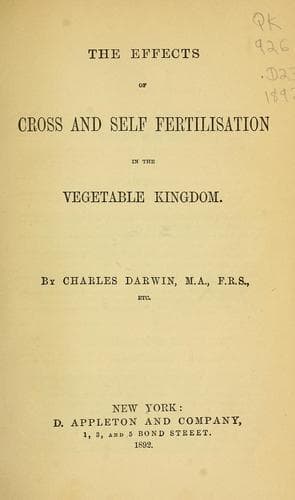
The Effects of Cross & Self-Fertilisation in the Vegetable KingdomDarwin, Charles
Science
The Effects of Cross & Self-Fertilisation in the Vegetable Kingdom
Darwin, Charles
Fertilization of plants; Plants -- Variation; Pollination
We have seen that seedlings from a cross between distinct plants almost
always exceed their self-fertilised opponents in height, weight, and
constitutional vigour, and, as will hereafter be shown, often in
fertility. To ascertain whether this superiority would be transmitted
beyond the first generation, seedlings were raised on three occasions
from crossed and self-fertilised plants, both sets being fertilised in
the same manner, and therefore not as in the many cases given in Tables
7/A, 7/B, 7/C, in which the crossed plants were again crossed and the
self-fertilised again self-fertilised.
Firstly, seedlings were raised from self-fertilised seeds produced under
a net by crossed and self-fertilised plants of Nemophila insignis; and
the latter were to the former in height as 133 to 100. But these
seedlings became very unhealthy early in life, and grew so unequally
that some of them in both lots were five times as tall as the others.
Therefore this experiment was quite worthless; but I have felt bound to
give it, as opposed to my general conclusion. I should state that in
this and the two following trials, both sets of plants were grown on the
opposite sides of the same pots, and treated in all respects alike. The
details of the experiments may be found under the head of each species.
Secondly, a crossed and a self-fertilised plant of Heartsease (Viola
tricolor) grew near together in the open ground and near to other plants
of heartsease; and as both produced an abundance of very fine capsules,
the flowers on both were certainly cross-fertilised by insects. Seeds
were collected from both plants, and seedlings raised from them. Those
from the crossed plants flowered in all three pots before those from the
self-fertilised plants; and when fully grown the former were to the
latter in height as 100 to 82. As both sets of plants were the product
of cross-fertilisation, the difference in their growth and period of
flowering was clearly due to their parents having been of crossed and
self-fertilised parentage; and it is equally clear that they transmitted
different constitutional powers to their offspring, the grandchildren of
the plants which were originally crossed and self-fertilised.
Public-domain text, read in full here on John Shaqi.
Reviews
Reviews
No reviews yet
Be the first to share your thoughts on this work.
Elsewhere in the archive
Join the Discussion
Join the discussion
Sign in to leave a comment or review.
Sign InorCreate an account