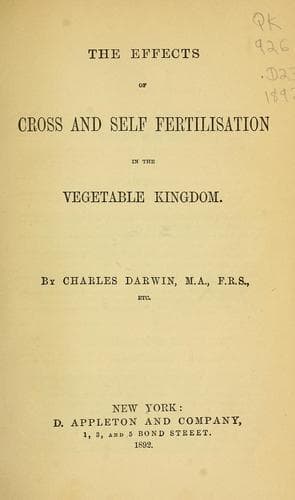
The Effects of Cross & Self-Fertilisation in the Vegetable KingdomDarwin, Charles
Science
The Effects of Cross & Self-Fertilisation in the Vegetable Kingdom
Darwin, Charles
Fertilization of plants; Plants -- Variation; Pollination
A plant which had been long cultivated in my kitchen garden, had spread
by stolons so as to form a large bed or clump. Seedlings raised by
intercrossing flowers on these plants, which strictly consisted of the
same plant, and other seedlings raised from self-fertilised flowers,
were carefully compared from their earliest youth to maturity; and they
did not differ at all in height or in constitutional vigour. Some
flowers on these seedlings were then crossed with pollen taken from a
distinct seedling, and other flowers were self-fertilised; two fresh
lots of seedlings being thus raised, which were the grandchildren of the
plant that had spread by stolons and formed a large clump in my garden.
These differed much in height, the crossed plants being to the
self-fertilised as 100 to 86. They differed, also, to a wonderful degree
in constitutional vigour. The crossed plants flowered first, and
produced exactly twice as many flower-stems; and they afterwards
increased by stolons to such an extent as almost to overwhelm the
self-fertilised plants.
Reviewing these five cases, we see that in four of them, the effect of a
cross between flowers on the same plant (even on offsets of the same
plant growing on separate roots, as with the Pelargonium and Origanum)
does not differ from that of the strictest self-fertilisation. Indeed,
in two of the cases the self-fertilised plants were superior to such
intercrossed plants. With Digitalis a cross between the flowers on the
same plant certainly did do some good, yet very slight compared with
that from a cross between distinct plants. On the whole the results here
arrived at, if we bear in mind that the flower-buds are to a certain
extent distinct individuals and occasionally vary independently of one
another, agree well with our general conclusion, that the advantages of
a cross depend on the progenitors of the crossed plants possessing
somewhat different constitutions, either from having been exposed to
different conditions, or to their having varied from unknown causes in a
manner which we in our ignorance are forced to speak of as spontaneous.
Hereafter I shall have to recur to this subject of the inefficiency of a
cross between the flowers on the same plant, when we consider the part
which insects play in the cross-fertilisation of flowers.
ON THE TRANSMISSION OF THE GOOD EFFECTS FROM A CROSS AND OF THE EVIL
EFFECTS FROM SELF-FERTILISATION.
Public-domain text, read in full here on John Shaqi.
Reviews
Reviews
No reviews yet
Be the first to share your thoughts on this work.
Elsewhere in the archive
Join the Discussion
Join the discussion
Sign in to leave a comment or review.
Sign InorCreate an account