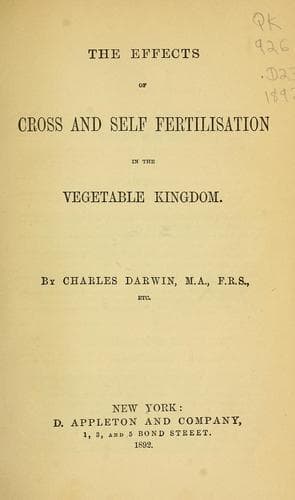
The Effects of Cross & Self-Fertilisation in the Vegetable KingdomDarwin, Charles
Science
The Effects of Cross & Self-Fertilisation in the Vegetable Kingdom
Darwin, Charles
Fertilization of plants; Plants -- Variation; Pollination
An allied point may be here noticed. As the force of inheritance is
strong with plants (of which abundant evidence could be given), it is
almost certain that seedlings from the same capsule or from the same
plant would tend to inherit nearly the same constitution; and as the
advantage from a cross depends on the plants which are crossed differing
somewhat in constitution, it may be inferred as probable that under
similar conditions a cross between the nearest relations would not
benefit the offspring so much as one between non-related plants. In
support of this conclusion we have some evidence, as Fritz Muller has
shown by his valuable experiments on hybrid Abutilons, that the union of
brothers and sisters, parents and children, and of other near relations
is highly injurious to the fertility of the offspring. In one case,
moreover, seedlings from such near relations possessed very weak
constitutions. (8/4. ‘Jenaische Zeitschrift fur Naturw.’ B. 7 pages 22
and 45 1872 and 1873 pages 441-450.) This same observer also found three
plants of a Bignonia growing near together. (8/5. ‘Botanische Zeitung’
1868 page 626.) He fertilised twenty-nine flowers on one of them with
their own pollen, and they did not set a single capsule. Thirty flowers
were then fertilised with pollen from a distinct plant, one of the three
growing together, and they yielded only two capsules. Lastly, five
flowers were fertilised with pollen from a fourth plant growing at a
distance, and all five produced capsules. It seems therefore probable,
as Fritz Muller suggests, that the three plants growing near together
were seedlings from the same parent, and that from being closely related
they had little power of fertilising one another. (8/6. Some remarkable
cases are given in my ‘Variation under Domestication’ chapter 17 2nd
edition volume 2 page 121, of hybrids of Gladiolus and Cistus, any one
of which could be fertilised by pollen from any other, but not by its
own pollen.)
Lastly, the fact of the intercrossed plants in Table 7/A not exceeding
in height the self-fertilised plants in a greater and greater degree in
the later generations, is probably the result of their having become
more and more closely inter-related.
UNIFORM COLOUR OF THE FLOWERS ON PLANTS, SELF-FERTILISED AND GROWN UNDER
SIMILAR CONDITIONS FOR SEVERAL GENERATIONS.
Public-domain text, read in full here on John Shaqi.
Reviews
Reviews
No reviews yet
Be the first to share your thoughts on this work.
Elsewhere in the archive
Join the Discussion
Join the discussion
Sign in to leave a comment or review.
Sign InorCreate an account