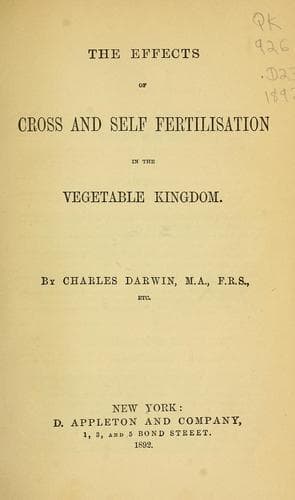
The Effects of Cross & Self-Fertilisation in the Vegetable KingdomDarwin, Charles
Science
The Effects of Cross & Self-Fertilisation in the Vegetable Kingdom
Darwin, Charles
Fertilization of plants; Plants -- Variation; Pollination
At the commencement of my experiments, the parent-plants of Mimulus
luteus, Ipomoea purpurea, Dianthus caryophyllus, and Petunia violacea,
raised from purchased seeds, varied greatly in the colour of their
flowers. This occurs with many plants which have been long cultivated as
an ornament for the flower-garden, and which have been propagated by
seeds. The colour of the flowers was a point to which I did not at first
in the least attend, and no selection whatever was practised.
Nevertheless, the flowers produced by the self-fertilised plants of the
above four species became absolutely uniform in tint, or very nearly so,
after they had been grown for some generations under closely similar
conditions. The intercrossed plants, which were more or less closely
inter-related in the later generations, and which had been likewise
cultivated all the time under similar conditions, became more uniform in
the colour of their flowers than were the original parent-plants, but
much less so than the self-fertilised plants. When self-fertilised
plants of one of the later generations were crossed with a fresh stock,
and seedlings thus raised, these presented a wonderful contrast in the
diversified tints of their flowers compared with those of the
self-fertilised seedlings. As such cases of flowers becoming uniformly
coloured without any aid from selection seem to me curious, I will give
a full abstract of my observations.
Mimulus luteus.
A tall variety, bearing large, almost white flowers blotched with
crimson, appeared amongst the intercrossed and self-fertilised plants of
the third and fourth generations. This variety increased so rapidly,
that in the sixth generation of self-fertilised plants every single one
consisted of it. So it was with all the many plants which were raised,
up to the last or ninth self-fertilised generation. Although this
variety first appeared amongst the intercrossed plants, yet from their
offspring being intercrossed in each succeeding generation, it never
prevailed amongst them; and the flowers on the several intercrossed
plants of the ninth generation differed considerably in colour. On the
other hand, the uniformity in colour of the flowers on the plants of all
the later self-fertilised generations was quite surprising; on a casual
inspection they might have been said to be quite alike, but the crimson
blotches were not of exactly the same shape, or in exactly the same
position. Both my gardener and myself believe that this variety did not
appear amongst the parent-plants, raised from purchased seeds, but from
its appearance amongst both the crossed and self-fertilised plants of
the third and fourth generations; and from what I have seen of the
variation of this species on other occasions, it is probable that it
would occasionally appear under any circumstances. We learn, however,
from the present case that under the peculiar conditions to which my
plants were subjected, this particular variety, remarkable for its
Public-domain text, read in full here on John Shaqi.
Reviews
Reviews
No reviews yet
Be the first to share your thoughts on this work.
Elsewhere in the archive
Join the Discussion
Join the discussion
Sign in to leave a comment or review.
Sign InorCreate an account