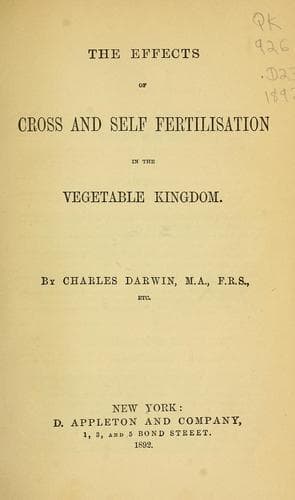
The Effects of Cross & Self-Fertilisation in the Vegetable KingdomDarwin, Charles
Science
The Effects of Cross & Self-Fertilisation in the Vegetable Kingdom
Darwin, Charles
Fertilization of plants; Plants -- Variation; Pollination
In this case I happened to record in my notes that the flowers on the
parent-plant which was first self-fertilised were of a “dingy purple
colour.” In the fifth self-fertilised generation, every one of the
twenty-one self-fertilised plants growing in pots, and all the many
plants in a long row out of doors, produced flowers of absolutely the
same tint, namely, of a dull, rather peculiar and ugly flesh colour;
therefore, considerably unlike those on the parent-plant. I believe that
this change of colour supervened quite gradually; but I kept no record,
as the point did not interest me until I was struck with the uniform
tint of the flowers on the self-fertilised plants of the fifth
generation. The flowers on the intercrossed plants of the corresponding
generation were mostly of the same dull flesh colour, but not nearly so
uniform as those on the self-fertilised plants, some few being very
pale, almost white. The self-fertilised plants which grew in a long row
in the open ground were also remarkable for their uniformity in height,
as were the intercrossed plants in a less degree, both lots being
compared with a large number of plants raised at the same time under
similar conditions from the self-fertilised plants of the fourth
generation crossed by a fresh stock. I regret that I did not attend to
the uniformity in height of the self-fertilised seedlings in the later
generations of the other species.
These few cases seem to me to possess much interest. We learn from them
that new and slight shades of colour may be quickly and firmly fixed,
independently of any selection, if the conditions are kept as nearly
uniform as is possible, and no intercrossing be permitted. With Mimulus,
not only a grotesque style of colouring, but a larger corolla and
increased height of the whole plant were thus fixed; whereas with most
plants which have been long cultivated for the flower-garden, no
character is more variable than that of colour, excepting perhaps that
of height. From the consideration of these cases we may infer that the
variability of cultivated plants in the above respects is due, firstly,
to their being subjected to somewhat diversified conditions, and,
secondly, to their being often intercrossed, as would follow from the
free access of insects. I do not see how this inference can be avoided,
as when the above plants were cultivated for several generations under
closely similar conditions, and were intercrossed in each generation,
the colour of their flowers tended in some degree to change and to
become uniform. When no intercrossing with other plants of the same
stock was allowed,--that is, when the flowers were fertilised with their
own pollen in each generation--their colour in the later generations
became as uniform as that of plants growing in a state of nature,
accompanied at least in one instance by much uniformity in the height of
the plants. But in saying that the diversified tints of the flowers on
Public-domain text, read in full here on John Shaqi.
Reviews
Reviews
No reviews yet
Be the first to share your thoughts on this work.
Elsewhere in the archive
Join the Discussion
Join the discussion
Sign in to leave a comment or review.
Sign InorCreate an account