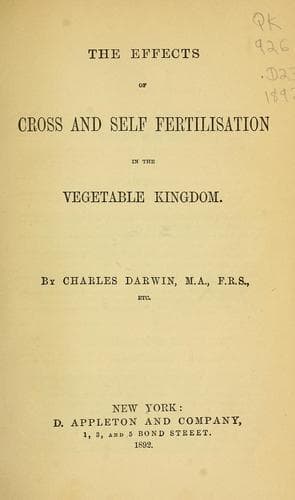
The Effects of Cross & Self-Fertilisation in the Vegetable KingdomDarwin, Charles
Science
The Effects of Cross & Self-Fertilisation in the Vegetable Kingdom
Darwin, Charles
Fertilization of plants; Plants -- Variation; Pollination
cultivated plants treated in the ordinary manner are due to differences
in the soil, climate, etc., to which they are exposed, I do not wish to
imply that such variations are caused by these agencies in any more
direct manner than that in which the most diversified illnesses, as
colds, inflammation of the lungs or pleura, rheumatism, etc., may be
said to be caused by exposure to cold. In both cases the constitution of
the being which is acted on is of preponderant importance.
CHAPTER IX.
THE EFFECTS OF CROSS-FERTILISATION AND SELF-FERTILISATION ON THE
PRODUCTION OF SEEDS.
Fertility of plants of crossed and self-fertilised parentage, both lots
being fertilised in the same manner.
Fertility of the parent-plants when first crossed and self-fertilised,
and of their crossed and self-fertilised offspring when again crossed
and self-fertilised.
Comparison of the fertility of flowers fertilised with their own pollen
and with that from other flowers on the same plant.
Self-sterile plants.
Causes of self-sterility.
The appearance of highly self-fertile varieties.
Self-fertilisation apparently in some respects beneficial, independently
of the assured production of seeds.
Relative weights and rates of germination of seeds from crossed and
self-fertilised flowers.
The present chapter is devoted to the Fertility of plants, as influenced
by cross-fertilisation and self-fertilisation. The subject consists of
two distinct branches; firstly, the relative productiveness or fertility
of flowers crossed with pollen from a distinct plant and with their own
pollen, as shown by the proportional number of capsules which they
produce, together with the number of the contained seeds. Secondly, the
degree of innate fertility or sterility of the seedlings raised from
crossed and self-fertilised seeds; such seedlings being of the same age,
grown under the same conditions, and fertilised in the same manner.
These two branches of the subject correspond with the two which have to
be considered by any one treating of hybrid plants; namely, in the first
place the comparative productiveness of a species when fertilised with
pollen from a distinct species and with its own pollen; and in the
second place, the fertility of its hybrid offspring. These two classes
of cases do not always run parallel; thus some plants, as Gartner has
shown, can be crossed with great ease, but yield excessively sterile
hybrids; while others are crossed with extreme difficulty, but yield
fairly fertile hybrids.
Public-domain text, read in full here on John Shaqi.
Reviews
Reviews
No reviews yet
Be the first to share your thoughts on this work.
Elsewhere in the archive
Join the Discussion
Join the discussion
Sign in to leave a comment or review.
Sign InorCreate an account