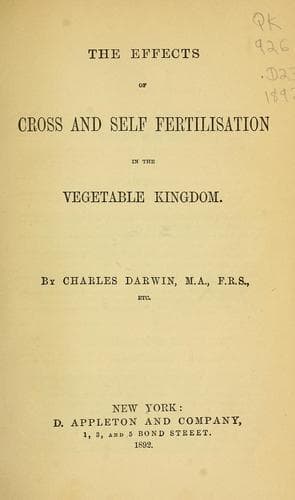
The Effects of Cross & Self-Fertilisation in the Vegetable KingdomDarwin, Charles
Science
The Effects of Cross & Self-Fertilisation in the Vegetable Kingdom
Darwin, Charles
Fertilization of plants; Plants -- Variation; Pollination
The natural order to follow in this chapter would have been first to
consider the effects on the fertility of the parent-plants of crossing
them, and of fertilising them with their own pollen; but as we have
discussed in the two last chapters the relative height, weight, and
constitutional vigour of crossed and self-fertilised plants--that is, of
plants raised from crossed and self-fertilised seeds--it will be
convenient here first to consider their relative fertility. The cases
observed by me are given in Table 9/D, in which plants of crossed and
self-fertilised parentage were left to fertilise themselves, being
either crossed by insects or spontaneously self-fertilised. It should be
observed that the results cannot be considered as fully trustworthy, for
the fertility of a plant is a most variable element, depending on its
age, health, nature of the soil, amount of water given, and temperature
to which it is exposed. The number of the capsules produced and the
number of the contained seeds, ought to have been ascertained on a large
number of crossed and self-fertilised plants of the same age and treated
in every respect alike. In these two latter respects my observations may
be trusted, but a sufficient number of capsules were counted only in a
few instances. The fertility, or as it may perhaps better be called the
productiveness, of a plant depends on the number of capsules produced,
and on the number of seeds which these contain. But from various causes,
chiefly from the want of time, I was often compelled to rely on the
number of the capsules alone. Nevertheless, in the more interesting
cases, the seeds were also counted or weighed. The average number of
seeds per capsule is a more valuable criterion of fertility than the
number of capsules produced. This latter circumstance depends partly on
the size of the plant; and we know that crossed plants are generally
taller and heavier than the self-fertilised; but the difference in this
respect is rarely sufficient to account for the difference in the number
of the capsules produced. It need hardly be added that in Table 9/D the
same number of crossed and self-fertilised plants are always compared.
Subject to the foregoing sources of doubt I will now give the table, in
which the parentage of the plants experimented on, and the manner of
determining their fertility are explained. Fuller details may be found
in the previous part of this work, under the head of each species.
TABLE 9/D.--RELATIVE FERTILITY OF PLANTS OF CROSSED AND SELF-FERTILISED
PARENTAGE, BOTH SETS BEING FERTILISED IN THE SAME MANNER. FERTILITY
JUDGED OF BY VARIOUS STANDARDS. THAT OF THE CROSSED PLANTS TAKEN AS 100.
Column 1: Name of plant and feature observed.
Column 2: x, in the expression, as 100 to x.
Ipomoea purpurea--first generation: seeds per capsule on crossed and
self-fertilised plants, not growing much crowded, spontaneously
self-fertilised under a net, in number: 99.
Public-domain text, read in full here on John Shaqi.
Reviews
Reviews
No reviews yet
Be the first to share your thoughts on this work.
Elsewhere in the archive
Join the Discussion
Join the discussion
Sign in to leave a comment or review.
Sign InorCreate an account