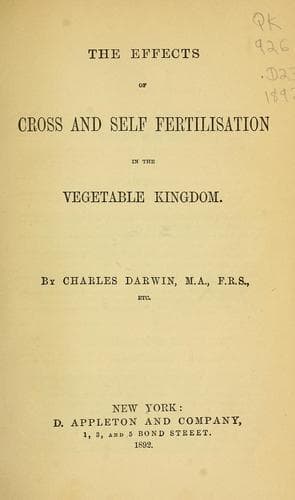
The Effects of Cross & Self-Fertilisation in the Vegetable KingdomDarwin, Charles
Science
The Effects of Cross & Self-Fertilisation in the Vegetable Kingdom
Darwin, Charles
Fertilization of plants; Plants -- Variation; Pollination
The fertility of the crossed plants is represented in Table 9/D by 100,
and that of the self-fertilised by the other figures. There are five
cases in which the fertility of the self-fertilised plants is
approximately equal to that of the crossed; nevertheless, in four of
these cases the crossed plants were plainly taller, and in the fifth
somewhat taller than the self-fertilised. But I should state that in
some of these five cases the fertility of the two lots was not strictly
ascertained, as the capsules were not actually counted, from appearing
equal in number and from all apparently containing a full complement of
seeds. In only two instances in the table, namely, with Vandellia and in
the third generation of Dianthus, the capsules on the self-fertilised
plants contained more seed than those on the crossed plants. With
Dianthus the ratio between the number of seeds contained in the
self-fertilised and crossed capsules was as 125 to 100; both sets of
plants were left to fertilise themselves under a net; and it is almost
certain that the greater fertility of the self-fertilised plants was
here due merely to their having varied and become less strictly
dichogamous, so as to mature their anthers and stigmas more nearly at
the same time than is proper to the species. Excluding the seven cases
now referred to, there remain twenty-six in which the crossed plants
were manifestly much more fertile, sometimes to an extraordinary degree,
than the self-fertilised with which they grew in competition. The most
striking instances are those in which plants derived from a cross with a
fresh stock are compared with plants of one of the later self-fertilised
generations; yet there are some striking cases, as that of Viola,
between the intercrossed plants of the same stock and the
self-fertilised, even in the first generation. The results most to be
trusted are those in which the productiveness of the plants was
ascertained by the number of capsules produced by an equal number of
plants, together with the actual or average number of seeds in each
capsule. Of such cases there are twelve in the table, and the mean of
their mean fertility is as 100 for the crossed plants, to 59 for the
self-fertilised plants. The Primulaceae seem eminently liable to suffer
in fertility from self-fertilisation.
The following short table, Table 9/E, includes four cases which have
already been partly given in the last table.
TABLE 9/E.--INNATE FERTILITY OF PLANTS FROM A CROSS WITH A FRESH STOCK,
COMPARED WITH THAT OF INTERCROSSED PLANTS OF THE SAME STOCK, AND WITH
THAT OF SELF-FERTILISED PLANTS, ALL OF THE CORRESPONDING GENERATION.
FERTILITY JUDGED OF BY THE NUMBER OR WEIGHT OF SEEDS PRODUCED BY AN
EQUAL NUMBER OF PLANTS.
Column 1: Name of plant and feature observed.
Column 2: Plants from a cross with a fresh stock.
Column 3: Intercrossed plants of the same stock.
Column 4: Self-fertilised plants.
Public-domain text, read in full here on John Shaqi.
Reviews
Reviews
No reviews yet
Be the first to share your thoughts on this work.
Elsewhere in the archive
Join the Discussion
Join the discussion
Sign in to leave a comment or review.
Sign InorCreate an account