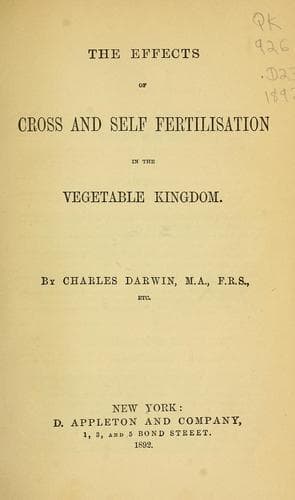
The Effects of Cross & Self-Fertilisation in the Vegetable KingdomDarwin, Charles
Science
The Effects of Cross & Self-Fertilisation in the Vegetable Kingdom
Darwin, Charles
Fertilization of plants; Plants -- Variation; Pollination
Mimulus luteus--the intercrossed plants are derived from a cross between
two plants of the 8th self-fertilised generation. The self-fertilised
plants belong to the 9th generation: 100 : 4 : 3.
Eschscholtzia californica--the intercrossed and self-fertilised plants
belong to the 2nd generation: 100 : 45 : 40.
Dianthus caryophyllus--the intercrossed plants are derived from
self-fertilised of the 3rd generation, crossed by intercrossed plants of
the 3rd generation. The self-fertilised plants belong to the 4th
generation: 100 : 45 : 33.
Petunia violacea--the intercrossed and self-fertilised plants belong to
the 5th generation: 100 : 54 : 46.
NB.--In the above cases, excepting in that of Eschscholtzia, the plants
derived from a cross with a fresh stock belong on the mother-side to the
same stock with the intercrossed and self-fertilised plants, and to the
corresponding generation.
These cases show us how greatly superior in innate fertility the
seedlings from plants self-fertilised or intercrossed for several
generations and then crossed by a fresh stock are, in comparison with
the seedlings from plants of the old stock, either intercrossed or
self-fertilised for the same number of generations. The three lots of
plants in each case were left freely exposed to the visits of insects,
and their flowers without doubt were cross-fertilised by them.
Table 9/E further shows us that in all four cases the intercrossed
plants of the same stock still have a decided though small advantage in
fertility over the self-fertilised plants.
With respect to the state of the reproductive organs in the
self-fertilised plants of Tables 9/D and 9/E, only a few observations
were made. In the seventh and eighth generation of Ipomoea, the anthers
in the flowers of the self-fertilised plants were plainly smaller than
those in the flowers of the intercrossed plants. The tendency to
sterility in these same plants was also shown by the first-formed
flowers, after they had been carefully fertilised, often dropping off,
in the same manner as frequently occurs with hybrids. The flowers
likewise tended to be monstrous. In the fourth generation of Petunia,
the pollen produced by the self-fertilised and intercrossed plants was
compared, and they were far more empty and shrivelled grains in the
former.
RELATIVE FERTILITY OF FLOWERS CROSSED WITH POLLEN FROM A DISTINCT PLANT
AND WITH THEIR OWN POLLEN. THIS HEADING INCLUDES FLOWERS ON THE
PARENT-PLANTS, AND ON THE CROSSED AND SELF-FERTILISED SEEDLINGS OF THE
FIRST OR A SUCCEEDING GENERATION.
Public-domain text, read in full here on John Shaqi.
The Effects of Cross & Self-Fertilisation in the Vegetable Kingdom — John Shaqi
Reviews
Reviews
No reviews yet
Be the first to share your thoughts on this work.
Elsewhere in the archive
Join the Discussion
Join the discussion
Sign in to leave a comment or review.
Sign InorCreate an account