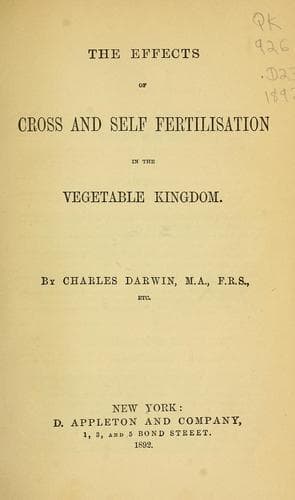
The Effects of Cross & Self-Fertilisation in the Vegetable KingdomDarwin, Charles
Science
The Effects of Cross & Self-Fertilisation in the Vegetable Kingdom
Darwin, Charles
Fertilization of plants; Plants -- Variation; Pollination
I will first treat of the parent-plants, which were raised from seeds
purchased from nursery-gardens, or taken from plants growing in my
garden, or growing wild, and surrounded in every case by many
individuals of the same species. Plants thus circumstanced will commonly
have been intercrossed by insects; so that the seedlings which were
first experimented on will generally have been the product of a cross.
Consequently any difference in the fertility of their flowers, when
crossed and self-fertilised, will have been caused by the nature of the
pollen employed; that is, whether it was taken from a distinct plant or
from the same flower. The degrees of fertility shown in Table 9/F, were
determined in each case by the average number of seeds per capsule,
ascertained either by counting or weighing.
Another element ought properly to have been taken into account, namely,
the proportion of flowers which yielded capsules when they were crossed
and self-fertilised; and as crossed flowers generally produce a larger
proportion of capsules, their superiority in fertility, if this element
had been taken into account, would have been much more strongly marked
than appears in Table 9/F. But had I thus acted, there would have been
greater liability to error, as pollen applied to the stigma at the wrong
time fails to produce any effect, independently of its greater or less
potency. A good illustration of the great difference in the results
which sometimes follows, if the number of capsules produced relatively
to the number of flowers fertilised be included in the calculation, was
afforded by Nolana prostrata. Thirty flowers on some plants of this
species were crossed and produced twenty-seven capsules, each containing
five seeds; thirty-two flowers on the same plants were self-fertilised
and produced only six capsules, each containing five seeds. As the
number of seeds per capsule is here the same, the fertility of the
crossed and self-fertilised flowers is given in Table 9/F as equal, or
as 100 to 100. But if the flowers which failed to produce capsules be
included, the crossed flowers yielded on an average 4.50 seeds, whilst
the self-fertilised flowers yielded only 0.94 seeds, so that their
relative fertility would have been as 100 to 21. I should here state
that it has been found convenient to reserve for separate discussion the
cases of flowers which are usually quite sterile with their own pollen.
TABLE 9/f.--relative fertility of the flowers on the parent-plants used
in my experiments, when fertilised with pollen from a distinct plant and
with their own pollen. Fertility judged of by the average number of
seeds per capsule. Fertility of crossed flowers taken as 100.
Column 1: Name of plant and feature observed.
Column 2: x, in the expression 100 to x.
Ipomoea purpurea--crossed and self-fertilised flowers yielded seeds as
(about): 100.
Mimulus luteus--crossed and self-fertilised flowers yielded seeds as (by
weight): 79.
Public-domain text, read in full here on John Shaqi.
Reviews
Reviews
No reviews yet
Be the first to share your thoughts on this work.
Elsewhere in the archive
Join the Discussion
Join the discussion
Sign in to leave a comment or review.
Sign InorCreate an account