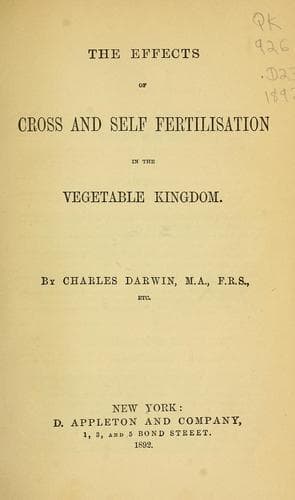
The Effects of Cross & Self-Fertilisation in the Vegetable KingdomDarwin, Charles
Science
The Effects of Cross & Self-Fertilisation in the Vegetable Kingdom
Darwin, Charles
Fertilization of plants; Plants -- Variation; Pollination
It might have been expected that the difference in fertility between the
crossed and self-fertilised flowers would have been more strongly marked
in Table 9/G, in which the plants of one set were derived from
self-fertilised parents, than in Table 9/F, in which flowers on the
parent-plants were self-fertilised for the first time. But this is not
the case, as far as my scanty materials allow of any judgment. There is
therefore no evidence at present, that the fertility of plants goes on
diminishing in successive self-fertilised generations, although there is
some rather weak evidence that this does occur with respect to their
height or growth. But we should bear in mind that in the later
generations the crossed plants had become more or less closely
inter-related, and had been subjected all the time to nearly uniform
conditions.
It is remarkable that there is no close correspondence, either in the
parent-plants or in the successive generations, between the relative
number of seeds produced by the crossed and self-fertilised flowers, and
the relative powers of growth of the seedlings raised from such seeds.
Thus, the crossed and self-fertilised flowers on the parent-plants of
Ipomoea, Gesneria, Salvia, Limnanthes, Lobelia fulgens, and Nolana
produced a nearly equal number of seeds, yet the plants raised from the
crossed seeds exceeded considerably in height those raised from the
self-fertilised seeds. The crossed flowers of Linaria and Viscaria
yielded far more seeds than the self-fertilised flowers; and although
the plants raised from the former were taller than those from the
latter, they were not so in any corresponding degree. With Nicotiana the
flowers fertilised with their own pollen were more productive than those
crossed with pollen from a slightly different variety; yet the plants
raised from the latter seeds were much taller, heavier, and more hardy
than those raised from the self-fertilised seeds. On the other hand, the
crossed seedlings of Eschscholtzia were neither taller nor heavier than
the self-fertilised, although the crossed flowers were far more
productive than the self-fertilised. But the best evidence of a want of
correspondence between the number of seeds produced by crossed and
self-fertilised flowers, and the vigour of the offspring raised from
them, is afforded by the plants of the Brazilian and European stocks of
Eschscholtzia, and likewise by certain individual plants of Reseda
odorata; for it might have been expected that the seedlings from plants,
the flowers of which were excessively self-sterile, would have profited
in a greater degree by a cross, than the seedlings from plants which
were moderately or fully self-fertile, and therefore apparently had no
need to be crossed. But no such result followed in either case: for
instance, the crossed and self-fertilised offspring from a highly
self-fertile plant of Reseda odorata were in average height to each
Public-domain text, read in full here on John Shaqi.
Reviews
Reviews
No reviews yet
Be the first to share your thoughts on this work.
Elsewhere in the archive
Join the Discussion
Join the discussion
Sign in to leave a comment or review.
Sign InorCreate an account