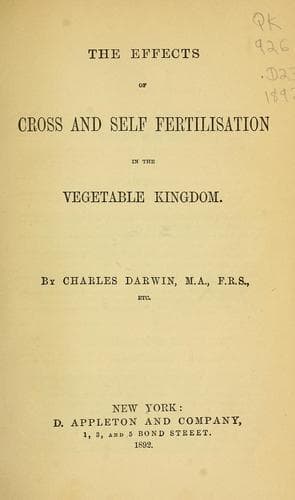
The Effects of Cross & Self-Fertilisation in the Vegetable KingdomDarwin, Charles
Science
The Effects of Cross & Self-Fertilisation in the Vegetable Kingdom
Darwin, Charles
Fertilization of plants; Plants -- Variation; Pollination
other as 100 to 82; whereas the similar offspring from an excessively
self-sterile plant were as 100 to 92 in average height.
With respect to the innate fertility of the plants of crossed and
self-fertilised parentage, given in the previous Table 9/D--that is, the
number of seeds produced by both lots when their flowers were fertilised
in the same manner,--nearly the same remarks are applicable, in
reference to the absence of any close correspondence between their
fertility and powers of growth, as in the case of the plants in the
Tables 9/F and 9/G, just considered. Thus the crossed and
self-fertilised plants of Ipomoea, Papaver, Reseda odorata, and
Limnanthes were almost equally fertile, yet the former exceeded
considerably in height the self-fertilised plants. On the other hand,
the crossed and self-fertilised plants of Mimulus and Primula differed
to an extreme degree in innate fertility, but by no means to a
corresponding degree in height or vigour.
In all the cases of self-fertilised flowers included in Tables 9/E, 9/F,
and 9/G, these were fertilised with their own pollen; but there is
another form of self-fertilisation, namely, by pollen from other flowers
on the same plant; but this latter method made no difference in
comparison with the former in the number of seeds produced, or only a
slight difference. Neither with Digitalis nor Dianthus were more seeds
produced by the one method than by the other, to any trustworthy degree.
With Ipomoea rather more seeds, in the proportion of 100 to 91, were
produced from a crossed between flowers on the same plant than from
strictly self-fertilised flowers; but I have reason to suspect that the
result was accidental. With Origanum vulgare, however, a cross between
flowers on plants propagated by stolons from the same stock certainly
increased slightly their fertility. This likewise occurred, as we shall
see in the next section, with Eschscholtzia, perhaps with Corydalis cava
and Oncidium; but not so with Bignonia, Abutilon, Tabernaemontana,
Senecio, and apparently Reseda odorata.
SELF-STERILE PLANTS.
The cases here to be described might have been introduced in Table 9/F,
which gives the relative fertility of flowers fertilised with their own
pollen, and with that from a distinct plant, but it has been found more
convenient to keep them for separate discussion. The present cases must
not be confounded with those to be given in the next chapter relatively
to flowers which are sterile when insects are excluded; for such
sterility depends not merely on the flowers being incapable of
fertilisation with their own pollen, but on mechanical causes, by which
their pollen is prevented from reaching the stigma, or on the pollen and
stigma of the same flower being matured at different periods.
Public-domain text, read in full here on John Shaqi.
Reviews
Reviews
No reviews yet
Be the first to share your thoughts on this work.
Elsewhere in the archive
Join the Discussion
Join the discussion
Sign in to leave a comment or review.
Sign InorCreate an account