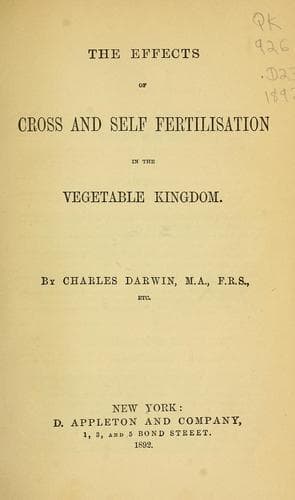
The Effects of Cross & Self-Fertilisation in the Vegetable KingdomDarwin, Charles
Science
The Effects of Cross & Self-Fertilisation in the Vegetable Kingdom
Darwin, Charles
Fertilization of plants; Plants -- Variation; Pollination
In the seventeenth chapter of my ‘Variation of Animals and Plants under
Domestication’ I had occasion to enter fully on the present subject; and
I will therefore here give only a brief abstract of the cases there
described, but others must be added, as they have an important bearing
on the present work. Kolreuter long ago described plants of Verbascum
phoeniceum which during two years were sterile with their own pollen,
but were easily fertilised by that of four other species; these plants
however afterwards became more or less self-fertile in a strangely
fluctuating manner. Mr. Scott also found that this species, as well as
two of its varieties, were self-sterile, as did Gartner in the case of
Verbascum nigrum. So it was, according to this latter author, with two
plants of Lobelia fulgens, though the pollen and ovules of both were in
an efficient state in relation to other species. Five species of
Passiflora and certain individuals of a sixth species have been found
sterile with their own pollen; but slight changes in their conditions,
such as being grafted on another stock or a change of temperature,
rendered them self-fertile. Flowers on a completely self-impotent plant
of Passiflora alata fertilised with pollen from its own self-impotent
seedlings were quite fertile. Mr. Scott, and afterwards Mr. Munro, found
that some species of Oncidium and of Maxillaria cultivated in a hothouse
in Edinburgh were quite sterile with their own pollen; and Fritz Muller
found this to be the case with a large number of Orchidaceous genera
growing in their native home of South Brazil. (9/2. ‘Botanische Zeitung’
1868 page 114.) He also discovered that the pollen-masses of some
orchids acted on their own stigmas like a poison; and it appears that
Gartner formerly observed indications of this extraordinary fact in the
case of some other plants.
Public-domain text, read in full here on John Shaqi.
Reviews
Reviews
No reviews yet
Be the first to share your thoughts on this work.
Elsewhere in the archive
Join the Discussion
Join the discussion
Sign in to leave a comment or review.
Sign InorCreate an account