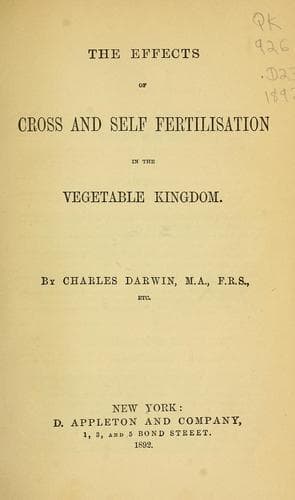
The Effects of Cross & Self-Fertilisation in the Vegetable KingdomDarwin, Charles
Science
The Effects of Cross & Self-Fertilisation in the Vegetable Kingdom
Darwin, Charles
Fertilization of plants; Plants -- Variation; Pollination
Two purple-flowered varieties were placed under a net in the greenhouse,
and four corymbs on each were repeatedly brushed with flowers from the
other plant, so that their stigmas were well covered with each other’s
pollen. Two of the eight corymbs thus treated produced very few seeds,
but the other six produced on an average 41.3 seeds per corymb, and
these germinated well. The stigmas on four other corymbs on both plants
were well smeared with pollen from the flowers on their own corymbs;
these eight corymbs produced altogether ten extremely poor seeds, which
proved incapable of germinating. I examined many flowers on both plants,
and found the stigmas spontaneously covered with pollen; but they
produced not a single seed. These plants were afterwards left uncovered
in the same house where many other Cinerarias were in flower; and the
flowers were frequently visited by bees. They then produced plenty of
seed, but one of the two plants less than the other, as this species
shows some tendency to be dioecious.
The trial was repeated on another variety with white petals tipped with
red. Many stigmas on two corymbs were covered with pollen from the
foregoing purple variety, and these produced eleven and twenty-two
seeds, which germinated well. A large number of the stigmas on several
of the other corymbs were repeatedly smeared with pollen from their own
corymb; but they yielded only five very poor seeds, which were incapable
of germination. Therefore the above three plants belonging to two
varieties, though growing vigorously and fertile with pollen from either
of the other two plants, were utterly sterile with pollen from other
flowers on the same plant.
Reseda odorata.
Having observed that certain individuals were self-sterile, I covered
during the summer of 1868 seven plants under separate nets, and will
call these plants A, B, C, D, E, F, G. They all appeared to be quite
sterile with their own pollen, but fertile with that of any other plant.
Fourteen flowers on A were crossed with pollen from B or C, and produced
thirteen fine capsules. Sixteen flowers were fertilised with pollen from
other flowers on the same plant, but yielded not a single capsule.
Fourteen flowers on B were crossed with pollen from A, C or D, and all
produced capsules; some of these were not very fine, yet they contained
plenty of seeds. Eighteen flowers were fertilised with pollen from other
flowers on the same plant, and produced not one capsule.
Ten flowers on C were crossed with pollen from A, B, D or E, and
produced nine fine capsules. Nineteen flowers were fertilised with
pollen from other flowers on the same plant, and produced no capsules.
Ten flowers on D were crossed with pollen from A, B, C or E, and
produced nine fine capsules. Eighteen flowers were fertilised with
pollen from other flowers on the same plant, and produced no capsules.
Public-domain text, read in full here on John Shaqi.
Reviews
Reviews
No reviews yet
Be the first to share your thoughts on this work.
Elsewhere in the archive
Join the Discussion
Join the discussion
Sign in to leave a comment or review.
Sign InorCreate an account