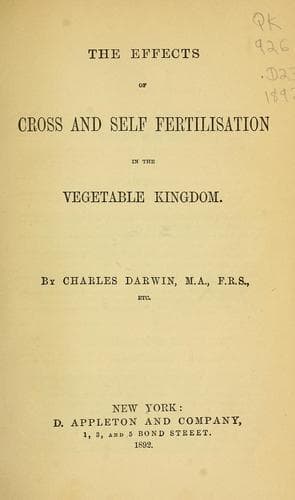
The Effects of Cross & Self-Fertilisation in the Vegetable KingdomDarwin, Charles
Science
The Effects of Cross & Self-Fertilisation in the Vegetable Kingdom
Darwin, Charles
Fertilization of plants; Plants -- Variation; Pollination
Seven flowers on E were crossed with pollen from A, C, or D, and all
produced fine capsules. Eight flowers were fertilised with pollen from
other flowers on the same plant, and produced no capsules.
On the plants F and G no flowers were crossed, but very many (number not
recorded) were fertilised with pollen from other flowers on the same
plants, and these did not produce a single capsule.
We thus see that fifty-five flowers on five of the above plants were
reciprocally crossed in various ways; several flowers on each of these
plants being fertilised with pollen from several of the other plants.
These fifty-five flowers produced fifty-two capsules, almost all of
which were of full size and contained an abundance of seeds. On the
other hand, seventy-nine flowers (besides many others not recorded) were
fertilised with pollen from other flowers on the same plants, and these
did not produce a single capsule. In one case in which I examined the
stigmas of the flowers fertilised with their own pollen, these were
penetrated by the pollen-tubes, although such penetration produced no
effect. Pollen falls generally, and I believe always, from the anthers
on the stigmas of the same flower; yet only three out of the above seven
protected plants produced spontaneously any capsules, and these it might
have been thought must have been self-fertilised. There were altogether
seven such capsules; but as they were all seated close to the
artificially crossed flowers, I can hardly doubt that a few grains of
foreign pollen had accidentally fallen on their stigmas. Besides the
above seven plants, four others were kept covered under the SAME large
net; and some of these produced here and there in the most capricious
manner little groups of capsules; and this makes me believe that a bee,
many of which settled on the outside of the net, being attracted by the
odour, had on some one occasion found an entrance, and had intercrossed
a few of the flowers.
In the spring of 1869 four plants raised from fresh seeds were carefully
protected under separate nets; and now the result was widely different
to what it was before. Three of these protected plants became actually
loaded with capsules, especially during the early part of the summer;
and this fact indicates that temperature produces some effect, but the
experiment given in the following paragraph shows that the innate
constitution of the plant is a far more important element. The fourth
plant produced only a few capsules, many of them of small size; yet it
was far more self-fertile than any of the seven plants tried during the
previous year. The flowers on four small branches of this
semi-self-sterile plant were smeared with pollen from one of the other
plants, and they all produced fine capsules.
Public-domain text, read in full here on John Shaqi.
Reviews
Reviews
No reviews yet
Be the first to share your thoughts on this work.
Elsewhere in the archive
Join the Discussion
Join the discussion
Sign in to leave a comment or review.
Sign InorCreate an account