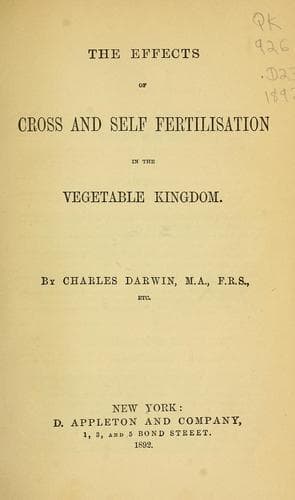
The Effects of Cross & Self-Fertilisation in the Vegetable KingdomDarwin, Charles
Science
The Effects of Cross & Self-Fertilisation in the Vegetable Kingdom
Darwin, Charles
Fertilization of plants; Plants -- Variation; Pollination
Plants of this species were raised from seeds gathered from a group of
wild plants growing at no great distance from my garden. After casually
observing that some of these plants were self-sterile, two plants taken
by hazard were protected under separate nets. One of these soon became
covered with spontaneously self-fertilised capsules, as numerous as
those on the surrounding unprotected plants; so that it was evidently
quite self-fertile. The other plant was partially self-sterile,
producing very few capsules, many of which were of small size. When,
however, this plant had grown tall, the uppermost branches became
pressed against the net and grew crooked, and in this position the bees
were able to suck the flowers through the meshes, and brought pollen to
them from the neighbouring plants. These branches then became loaded
with capsules; the other and lower branches remaining almost bare. The
sexual constitution of this species is therefore similar to that of
Reseda odorata.
CONCLUDING REMARKS ON SELF-STERILE PLANTS.
In order to favour as far as possible the self-fertilisation of some of
the foregoing plants, all the flowers on Reseda odorata and some of
those on the Abutilon were fertilised with pollen from other flowers on
the same plant, instead of with their own pollen, and in the case of the
Senecio with pollen from other flowers on the same corymb; but this made
no difference in the result. Fritz Muller tried both kinds of
self-fertilisation in the case of Bignonia, Tabernaemontana and
Abutilon, likewise with no difference in the result. With Eschscholtzia,
however, he found that pollen from other flowers on the same plant was a
little more effective than pollen from the same flower. So did
Hildebrand in Germany; as thirteen out of fourteen flowers of
Eschscholtzia thus fertilised set capsules, these containing on an
average 9.5 seeds; whereas only fourteen flowers out of twenty-one
fertilised with their own pollen set capsules, these containing on an
average 9.0 seeds. (9/11. ‘Pringsheim’s Jahrbuch fur wiss. Botanik’ 7
page 467.) Hildebrand found a trace of a similar difference with
Corydalis cava, as did Fritz Muller with an Oncidium. (9/12. ‘Variation
under Domestication’ chapter 17 2nd edition volume 2 pages 113-115.)
Public-domain text, read in full here on John Shaqi.
Reviews
Reviews
No reviews yet
Be the first to share your thoughts on this work.
Elsewhere in the archive
Join the Discussion
Join the discussion
Sign in to leave a comment or review.
Sign InorCreate an account