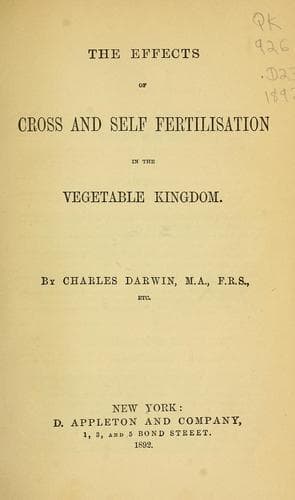
The Effects of Cross & Self-Fertilisation in the Vegetable KingdomDarwin, Charles
Science
The Effects of Cross & Self-Fertilisation in the Vegetable Kingdom
Darwin, Charles
Fertilization of plants; Plants -- Variation; Pollination
As I was much surprised at the difference in the results of the trials
made during the two previous years, six fresh plants were protected by
separate nets in the year 1870. Two of these proved almost completely
self-sterile, for on carefully searching them I found only three small
capsules, each containing either one or two seeds of small size, which,
however, germinated. A few flowers on both these plants were
reciprocally fertilised with each other’s pollen, and a few with pollen
from one of the following self-fertile plants, and all these flowers
produced fine capsules. The four other plants whilst still remaining
protected beneath the nets presented a wonderful contrast (though one of
them in a somewhat less degree than the others), for they became
actually covered with spontaneously self-fertilised capsules, as
numerous as, or very nearly so, and as fine as those on the unprotected
plants growing near.
The above three spontaneously self-fertilised capsules produced by the
two almost completely self-sterile plants, contained altogether five
seeds; and from these I raised in the following year (1871) five plants,
which were kept under separate nets. They grew to an extraordinarily
large size, and on August 29th were examined. At first sight they
appeared entirely destitute of capsules; but on carefully searching
their many branches, two or three capsules were found on three of the
plants, half-a-dozen on the fourth, and about eighteen on the fifth
plant. But all these capsules were small, some being empty; the greater
number contained only a single seed, and very rarely more than one.
After this examination the nets were taken off, and the bees immediately
carried pollen from one of these almost self-sterile plants to the
other, for no other plants grew near. After a few weeks the ends of the
branches on all five plants became covered with capsules, presenting a
curious contrast with the lower and naked parts of the same long
branches. These five plants therefore inherited almost exactly the same
sexual constitution as their parents; and without doubt a self-sterile
race of Mignonette could have been easily established.
Reseda lutea.
Public-domain text, read in full here on John Shaqi.
Reviews
Reviews
No reviews yet
Be the first to share your thoughts on this work.
Elsewhere in the archive
Join the Discussion
Join the discussion
Sign in to leave a comment or review.
Sign InorCreate an account