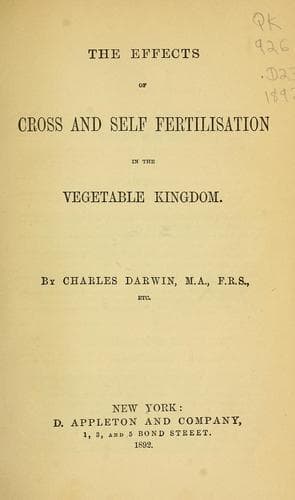
The Effects of Cross & Self-Fertilisation in the Vegetable KingdomDarwin, Charles
Science
The Effects of Cross & Self-Fertilisation in the Vegetable Kingdom
Darwin, Charles
Fertilization of plants; Plants -- Variation; Pollination
Self-sterility differs much in degree in different plants. In those
extraordinary cases in which pollen from the same flower acts on the
stigma like a poison, it is almost certain that the plants would never
yield a single self-fertilised seed. Other plants, like Corydalis cava,
occasionally, though very rarely, produce a few self-fertilised seeds. A
large number of species, as may be seen in Table 9/F, are less fertile
with their own pollen than with that from another plant; and lastly,
some species are perfectly self-fertile. Even with the individuals of
the same species, as just remarked, some are utterly self-sterile,
others moderately so, and some perfectly self-fertile. The cause,
whatever it may be, which renders many plants more or less sterile with
their own pollen, that is, when they are self-fertilised, must be
different, at least to a certain extent, from that which determines the
difference in height, vigour, and fertility of the seedlings raised from
self-fertilised and crossed seeds; for we have already seen that the two
classes of cases do not by any means run parallel. This want of
parallelism would be intelligible, if it could be shown that
self-sterility depended solely on the incapacity of the pollen-tubes to
penetrate the stigma of the same flower deeply enough to reach the
ovules; whilst the greater or less vigorous growth of the seedlings no
doubt depends on the nature of the contents of the pollen-grains and
ovules. Now it is certain that with some plants the stigmatic secretion
does not properly excite the pollen-grains, so that the tubes are not
properly developed, if the pollen is taken from the same flower. This is
the case according to Fritz Muller with Eschscholtzia, for he found that
the pollen-tubes did not penetrate the stigma deeply; and with the
Orchidaceous genus Notylia they failed altogether to penetrate it.
(9/14. ‘Botanische Zeitung’ 1868 pages 114, 115.)
With dimorphic and trimorphic species, an illegitimate union between
plants of the same form presents the closest analogy with
self-fertilisation, whilst a legitimate union closely resembles
cross-fertilisation; and here again the lessened fertility or complete
sterility of an illegitimate union depends, at least in part, on the
incapacity for interaction between the pollen-grains and stigma. Thus
with Linum grandiflorum, as I have elsewhere shown, not more than two or
three out of hundreds of pollen-grains, either of the long-styled or
short-styled form, when placed on the stigma of their own form, emit
their tubes, and these do not penetrate deeply; nor does the stigma
itself change colour, as occurs when it is legitimately fertilised.
(9/15. ‘Journal of the Linnean Society Botany’ volume 7 1863 pages
73-75.)
Public-domain text, read in full here on John Shaqi.
Reviews
Reviews
No reviews yet
Be the first to share your thoughts on this work.
Elsewhere in the archive
Join the Discussion
Join the discussion
Sign in to leave a comment or review.
Sign InorCreate an account