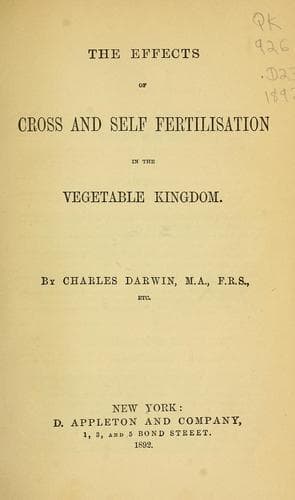
The Effects of Cross & Self-Fertilisation in the Vegetable KingdomDarwin, Charles
Science
The Effects of Cross & Self-Fertilisation in the Vegetable Kingdom
Darwin, Charles
Fertilization of plants; Plants -- Variation; Pollination
On the other hand the difference in innate fertility, as well as in
growth between plants raised from crossed and self-fertilised seeds, and
the difference in fertility and growth between the legitimate and
illegitimate offspring of dimorphic and trimorphic plants, must depend
on some incompatibility between the sexual elements contained within the
pollen-grains and ovules, as it is through their union that new
organisms are developed.
If we now turn to the more immediate cause of self-sterility, we clearly
see that in most cases it is determined by the conditions to which the
plants have been subjected. Thus Eschscholtzia is completely
self-sterile in the hot climate of Brazil, but is perfectly fertile
there with the pollen of any other individual. The offspring of
Brazilian plants became in England in a single generation partially
self-fertile, and still more so in the second generation. Conversely,
the offspring of English plants, after growing for two seasons in
Brazil, became in the first generation quite self-sterile. Again,
Abutilon darwinii, which is self-sterile in its native home of Brazil,
became moderately self-fertile in a single generation in an English
hothouse. Some other plants are self-sterile during the early part of
the year, and later in the season become self-fertile. Passiflora alata
lost its self-sterility when grafted on another species. With Reseda,
however, in which some individuals of the same parentage are
self-sterile and others are self-fertile, we are forced in our ignorance
to speak of the cause as due to spontaneous variability; but we should
remember that the progenitors of these plants, either on the male or
female side, may have been exposed to somewhat different conditions. The
power of the environment thus to affect so readily and in so peculiar a
manner the reproductive organs, is a fact which has many important
bearings; and I have therefore thought the foregoing details worth
giving. For instance, the sterility of many animals and plants under
changed conditions of life, such as confinement, evidently comes within
the same general principle of the sexual system being easily affected by
the environment. It has already been proved, that a cross between plants
which have been self-fertilised or intercrossed during several
generations, having been kept all the time under closely similar
conditions, does not benefit the offspring; and on the other hand, that
a cross between plants that have been subjected to different conditions
benefits the offspring to an extraordinary degree. We may therefore
conclude that some degree of differentiation in the sexual system is
necessary for the full fertility of the parent-plants and for the full
vigour of their offspring. It seems also probable that with those plants
which are capable of complete self-fertilisation, the male and female
elements and organs already differ to an extent sufficient to excite
Public-domain text, read in full here on John Shaqi.
Reviews
Reviews
No reviews yet
Be the first to share your thoughts on this work.
Elsewhere in the archive
Join the Discussion
Join the discussion
Sign in to leave a comment or review.
Sign InorCreate an account