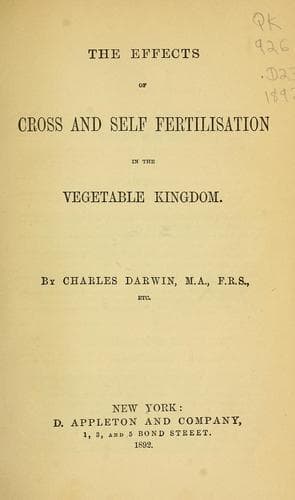
The Effects of Cross & Self-Fertilisation in the Vegetable KingdomDarwin, Charles
Science
The Effects of Cross & Self-Fertilisation in the Vegetable Kingdom
Darwin, Charles
Fertilization of plants; Plants -- Variation; Pollination
wish to maintain that self-sterility may not sometimes be of service to
a plant in preventing self-fertilisation; but there are so many other
means by which this result might be prevented or rendered difficult,
including as we shall see in the next chapter the prepotency of pollen
from a distinct individual over a plant’s own pollen, that
self-sterility seems an almost superfluous acquirement for this purpose.
Finally, the most interesting point in regard to self-sterile plants is
the evidence which they afford of the advantage, or rather of the
necessity, of some degree or kind of differentiation in the sexual
elements, in order that they should unite and give birth to a new being.
It was ascertained that the five plants of Reseda odorata which were
selected by chance, could be perfectly fertilised by pollen taken from
any one of them, but not by their own pollen; and a few additional
trials were made with some other individuals, which I have not thought
worth recording. So again, Hildebrand and Fritz Muller frequently speak
of self-sterile plants being fertile with the pollen of any other
individual; and if there had been any exceptions to the rule, these
could hardly have escaped their observation and my own. We may therefore
confidently assert that a self-sterile plant can be fertilised by the
pollen of any one out of a thousand or ten thousand individuals of the
same species, but not by its own. Now it is obviously impossible that
the sexual organs and elements of every individual can have been
specialised with respect to every other individual. But there is no
difficulty in believing that the sexual elements of each differ slightly
in the same diversified manner as do their external characters; and it
has often been remarked that no two individuals are absolutely alike.
Therefore we can hardly avoid the conclusion, that differences of an
analogous and indefinite nature in the reproductive system are
sufficient to excite the mutual action of the sexual elements, and that
unless there be such differentiation fertility fails.
THE APPEARANCE OF HIGHLY SELF-FERTILE VARIETIES.
We have just seen that the degree to which flowers are capable of being
fertilised with their own pollen differs much, both with the species of
the same genus, and sometimes with the individuals of the same species.
Some allied cases of the appearance of varieties which, when
self-fertilised, yield more seed and produce offspring growing taller
than their self-fertilised parents, or than the intercrossed plants of
the corresponding generation, will now be considered.
Public-domain text, read in full here on John Shaqi.
Reviews
Reviews
No reviews yet
Be the first to share your thoughts on this work.
Elsewhere in the archive
Join the Discussion
Join the discussion
Sign in to leave a comment or review.
Sign InorCreate an account