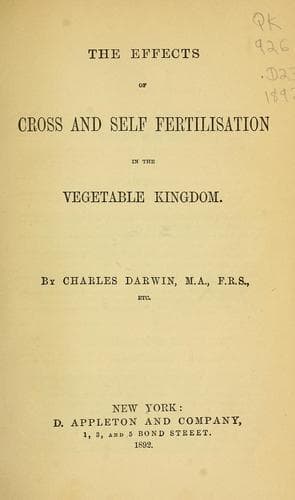
The Effects of Cross & Self-Fertilisation in the Vegetable KingdomDarwin, Charles
Science
The Effects of Cross & Self-Fertilisation in the Vegetable Kingdom
Darwin, Charles
Fertilization of plants; Plants -- Variation; Pollination
their mutual interaction; but that when such plants are taken to another
country, and become in consequence self-sterile, their sexual elements
and organs are so acted on as to be rendered too uniform for such
interaction, like those of a self-fertilised plant long cultivated under
the same conditions. Conversely, we may further infer that plants which
are self-sterile in their native country, but become self-fertile under
changed conditions, have their sexual elements so acted on, that they
become sufficiently differentiated for mutual interaction.
We know that self-fertilised seedlings are inferior in many respects to
those from a cross; and as with plants in a state of nature pollen from
the same flower can hardly fail to be often left by insects or by the
wind on the stigma, it seems at first sight highly probable that
self-sterility has been gradually acquired through natural selection in
order to prevent self-fertilisation. It is no valid objection to this
belief that the structure of some flowers, and the dichogamous condition
of many others, suffice to prevent the pollen reaching the stigma of the
same flower; for we should remember that with most species many flowers
expand at the same time, and that pollen from the same plant is equally
injurious or nearly so as that from the same flower. Nevertheless, the
belief that self-sterility is a quality which has been gradually
acquired for the special purpose of preventing self-fertilisation must,
I believe, be rejected. In the first place, there is no close
correspondence in degree between the sterility of the parent-plants when
self-fertilised, and the extent to which their offspring suffer in
vigour by this process; and some such correspondence might have been
expected if self-sterility had been acquired on account of the injury
caused by self-fertilisation. The fact of individuals of the same
parentage differing greatly in their degree of self-sterility is
likewise opposed to such a belief; unless, indeed, we suppose that
certain individuals have been rendered self-sterile to favour
intercrossing, whilst other individuals have been rendered self-fertile
to ensure the propagation of the species. The fact of self-sterile
individuals appearing only occasionally, as in the case of Lobelia, does
not countenance this latter view. But the strongest argument against the
belief that self-sterility has been acquired to prevent
self-fertilisation, is the immediate and powerful effect of changed
conditions in either causing or in removing self-sterility. We are not
therefore justified in admitting that this peculiar state of the
reproductive system has been gradually acquired through natural
selection; but we must look at it as an incidental result, dependent on
the conditions to which the plants have been subjected, like the
ordinary sterility caused in the case of animals by confinement, and in
the case of plants by too much manure, heat, etc. I do not, however,
Public-domain text, read in full here on John Shaqi.
Reviews
Reviews
No reviews yet
Be the first to share your thoughts on this work.
Elsewhere in the archive
Join the Discussion
Join the discussion
Sign in to leave a comment or review.
Sign InorCreate an account