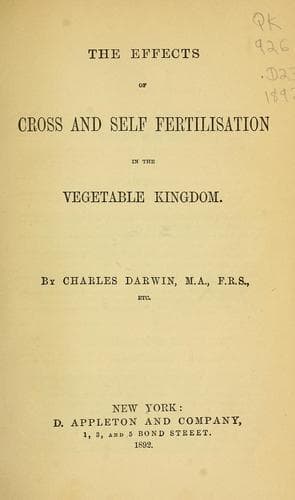
The Effects of Cross & Self-Fertilisation in the Vegetable KingdomDarwin, Charles
Science
The Effects of Cross & Self-Fertilisation in the Vegetable Kingdom
Darwin, Charles
Fertilization of plants; Plants -- Variation; Pollination
In Pot 3, on the opposite sides of which a large number of crossed and
self-fertilised seeds had been sown and the seedlings allowed to
struggle together, the crossed plants had at first no great advantage.
At one time the tallest crossed was 25 1/8 inches high, and the tallest
self-fertilised plants 21 3/8. But the difference afterwards became much
greater. The plants on both sides, from being so crowded, were poor
specimens. The flowers were allowed to fertilise themselves
spontaneously under a net; the crossed plants produced thirty-seven
capsules, the self-fertilised plants only eighteen, or as 100 to 47. The
former contained on an average 3.62 seeds per capsule; and the latter
3.38 seeds, or as 100 to 93. Combining these data (i.e., number of
capsules and average number of seeds), the crowded crossed plants
produced seeds compared with the self-fertilised as 100 to 45. These
latter seeds, however, were decidedly heavier, a hundred weighing 41.64
grains, than those from the capsules on the crossed plants, of which a
hundred weighed 36.79 grains; and this probably was due to the fewer
capsules borne by the self-fertilised plants having been better
nourished. We thus see that the crossed plants in this the first
generation, when grown under favourable conditions, and when grown under
unfavourable conditions from being much crowded, greatly exceeded in
height, and in the number of capsules produced, and slightly in the
number of seeds per capsule, the self-fertilised plants.
CROSSED AND SELF-FERTILISED PLANTS OF THE SECOND GENERATION.
Flowers on the crossed plants of the last generation (Table 2/1) were
crossed by pollen from distinct plants of the same generation; and
flowers on the self-fertilised plants were fertilised by pollen from the
same flower. The seeds thus produced were treated in every respect as
before, and we have in Table 2/2 the result.
TABLE 2/2. Ipomoea purpurea (Second Generation.).
Heights of Plants in inches:
Column 1: Number (Name) of Pot.
Column 2: Crossed Plants.
Column 3: Self-fertilised Plants.
Pot 1 : 87 : 67 4/8.
Pot 1 : 83 : 68 4/8.
Pot 1 : 83 : 80 4/8.
Pot 2 : 85 4/8 : 61 4/8.
Pot 2 : 89 : 79.
Pot 2 : 77 4/8 : 41.
Total : 505 : 398.
Here again every single crossed plant is taller than its antagonist. The
self-fertilised plant in Pot 1, which ultimately reached the unusual
height of 80 4/8 inches, was for a long time taller than the opposed
crossed plant, though at last beaten by it. The average height of the
six crossed plants is 84.16 inches, whilst that of the six
self-fertilised plants is 66.33 inches, or as 100 to 79.
CROSSED AND SELF-FERTILISED PLANTS OF THE THIRD GENERATION.
Seeds from the crossed plants of the last generation (Table 2/2) again
crossed, and from the self-fertilised plants again self-fertilised, were
treated in all respects exactly as before, with the following result:--
TABLE 2/3. Ipomoea purpurea (Third Generation.).
Public-domain text, read in full here on John Shaqi.
Reviews
Reviews
No reviews yet
Be the first to share your thoughts on this work.
Join the Discussion
Join the discussion
Sign in to leave a comment or review.
Sign InorCreate an account