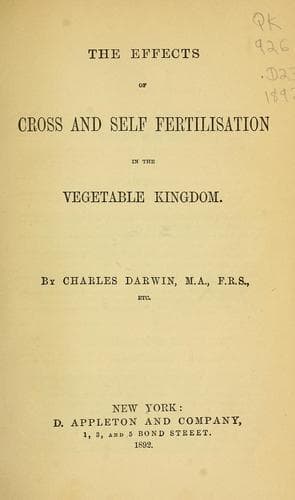
The Effects of Cross & Self-Fertilisation in the Vegetable KingdomDarwin, Charles
Science
The Effects of Cross & Self-Fertilisation in the Vegetable Kingdom
Darwin, Charles
Fertilization of plants; Plants -- Variation; Pollination
I tried in several ways the comparative vigour and powers of growth of
the crossed and self-fertilised plants of this third generation. Thus,
four self-fertilised seeds which had just germinated were planted on one
side of a pot, and after an interval of forty-eight hours, four crossed
seeds in the same state of germination were planted on the opposite
side; and the pot was kept in the hothouse. I thought that the advantage
thus given to the self-fertilised seedlings would have been so great
that they would never have been beaten by the crossed ones. They were
not beaten until all had grown to a height of 18 inches; and the degree
to which they were finally beaten is shown in Table 2/4. We here see
that the average height of the four crossed plants is 76.62, and of the
four self-fertilised plants 65.87 inches, or as 100 to 86; therefore
less than when both sides started fair.
TABLE 2/4. Ipomoea purpurea (Third Generation, the self-fertilised
plants having had a start of forty-eight hours).
Heights of Plants in inches:
Column 1: Number (Name) of Pot.
Column 2: Crossed Plants.
Column 3: Self-fertilised Plants.
Pot 3 : 78 4/8 : 73 4/8.
Pot 3 : 77 4/8 : 53.
Pot 3 : 73 : 61 4/8.
Pot 3 : 77 4/8 : 75 4/8.
Total : 306.5 : 263.5.
Crossed and self-fertilised seeds of the third generation were also sown
out of doors late in the summer, and therefore under unfavourable
conditions, and a single stick was given to each lot of plants to twine
up. The two lots were sufficiently separate so as not to interfere with
each other’s growth, and the ground was clear of weeds. As soon as they
were killed by the first frost (and there was no difference in their
hardiness), the two tallest crossed plants were found to be 24.5 and
22.5 inches, whilst the two tallest self-fertilised plants were only 15
and 12.5 inches in height, or as 100 to 59.
I likewise sowed at the same time two lots of the same seeds in a part
of the garden which was shady and covered with weeds. The crossed
seedlings from the first looked the most healthy, but they twined up a
stick only to a height of 7 1/4 inches; whilst the self-fertilised were
not able to twine at all; and the tallest of them was only 3 1/2 inches
in height.
Lastly, two lots of the same seeds were sown in the midst of a bed of
candy-tuft (Iberis) growing vigorously. The seedlings came up, but all
the self-fertilised ones soon died excepting one, which never twined and
grew to a height of only 4 inches. Many of the crossed seedlings, on the
other hand, survived; and some twined up the stems of the Iberis to the
height of 11 inches. These cases prove that the crossed seedlings have
an immense advantage over the self-fertilised, both when growing
isolated under very unfavourable conditions, and when put into
competition with each other or with other plants, as would happen in a
state of nature.
CROSSED AND SELF-FERTILISED PLANTS OF THE FOURTH GENERATION.
Public-domain text, read in full here on John Shaqi.
Reviews
Reviews
No reviews yet
Be the first to share your thoughts on this work.
Join the Discussion
Join the discussion
Sign in to leave a comment or review.
Sign InorCreate an account