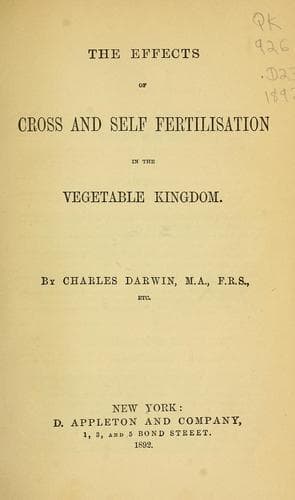
The Effects of Cross & Self-Fertilisation in the Vegetable KingdomDarwin, Charles
Science
The Effects of Cross & Self-Fertilisation in the Vegetable Kingdom
Darwin, Charles
Fertilization of plants; Plants -- Variation; Pollination
The flowers of the common Foxglove are proterandrous; that is, the
pollen is mature and mostly shed before the stigma of the same flower is
ready for fertilisation. This is effected by the larger humble-bees,
which, whilst in search of nectar, carry pollen from flower to flower.
The two upper and longer stamens shed their pollen before the two lower
and shorter ones. The meaning of this fact probably is, as Dr. Ogle
remarks, that the anthers of the longer stamens stand near to the
stigma, so that they would be the most likely to fertilise it (3/3.
‘Popular Science Review’ January 1870 page 50.); and as it is an
advantage to avoid self-fertilisation, they shed their pollen first,
thus lessening the chance. There is, however, but little danger of
self-fertilisation until the bifid stigma opens; for Hildebrand found
that pollen placed on the stigma before it had opened produced no
effect. (3/4. ‘Geschlechter-Vertheilung bei den Pflanzen’ 1867 page 20.)
The anthers, which are large, stand at first transversely with respect
to the tubular corolla, and if they were to dehisce in this position
they would, as Dr. Ogle also remarks, smear with pollen the whole back
and sides of an entering humble-bee in a useless manner; but the anthers
twist round and place themselves longitudinally before they dehisce. The
lower and inner side of the mouth of the corolla is thickly clothed with
hairs, and these collect so much of the fallen pollen that I have seen
the under surface of a humble-bee thickly dusted with it; but this can
never be applied to the stigma, as the bees in retreating do not turn
their under surfaces upwards. I was therefore puzzled whether these
hairs were of any use; but Mr. Belt has, I think, explained their use:
the smaller kinds of bees are not fitted to fertilise the flowers, and
if they were allowed to enter easily they would steal much nectar, and
fewer large bees would haunt the flowers. Humble-bees can crawl into the
dependent flowers with the greatest ease, using the “hairs as footholds
while sucking the honey; but the smaller bees are impeded by them, and
when, having at length struggled through them, they reach the slippery
precipice above, they are completely baffled.” Mr. Belt says that he
watched many flowers during a whole season in North Wales, and “only
once saw a small bee reach the nectary, though many were seen trying in
vain to do so.” (3/5. ‘The Naturalist in Nicaragua’ 1874 page 132. But
it appears from H. Muller ‘Die Befruchtung der Blumen’ 1873 page 285,
that small insects sometimes succeed in entering the flowers.)
Public-domain text, read in full here on John Shaqi.
Reviews
Reviews
No reviews yet
Be the first to share your thoughts on this work.
Elsewhere in the archive
Join the Discussion
Join the discussion
Sign in to leave a comment or review.
Sign InorCreate an account