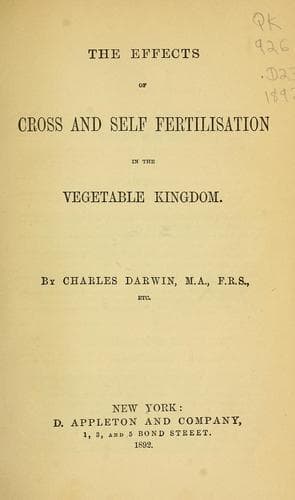
The Effects of Cross & Self-Fertilisation in the Vegetable KingdomDarwin, Charles
Science
The Effects of Cross & Self-Fertilisation in the Vegetable Kingdom
Darwin, Charles
Fertilization of plants; Plants -- Variation; Pollination
I covered a plant growing in its native soil in North Wales with a net,
and fertilised six flowers each with its own pollen, and six others with
pollen from a distinct plant growing within the distance of a few feet.
The covered plant was occasionally shaken with violence, so as to
imitate the effects of a gale of wind, and thus to facilitate as far as
possible self-fertilisation. It bore ninety-two flowers (besides the
dozen artificially fertilised), and of these only twenty-four produced
capsules; whereas almost all the flowers on the surrounding uncovered
plants were fruitful. Of the twenty-four spontaneously self-fertilised
capsules, only two contained their full complement of seed; six
contained a moderate supply; and the remaining sixteen extremely few
seeds. A little pollen adhering to the anthers after they had dehisced,
and accidentally falling on the stigma when mature, must have been the
means by which the above twenty-four flowers were partially
self-fertilised; for the margins of the corolla in withering do not curl
inwards, nor do the flowers in dropping off turn round on their axes, so
as to bring the pollen-covered hairs, with which the lower surface is
clothed, into contact with the stigma--by either of which means
self-fertilisation might be effected.
Seeds from the above crossed and self-fertilised capsules, after
germinating on bare sand, were planted in pairs on the opposite sides of
five moderately-sized pots, which were kept in the greenhouse. The
plants after a time appeared starved, and were therefore, without being
disturbed, turned out of their pots, and planted in the open ground in
two close parallel rows. They were thus subjected to tolerably severe
competition with one another; but not nearly so severe as if they had
been left in the pots. At the time when they were turned out, their
leaves were between 5 and 8 inches in length, and the longest leaf on
the finest plant on each side of each pot was measured, with the result
that the leaves of the crossed plants exceeded, on an average, those of
the self-fertilised plants by .4 of an inch.
In the following summer the tallest flower-stem on each plant, when
fully grown, was measured. There were seventeen crossed plants; but one
did not produce a flower-stem. There were also, originally, seventeen
self-fertilised plants, but these had such poor constitutions that no
less than nine died in the course of the winter and spring, leaving only
eight to be measured, as in Table 3/23.
TABLE 3/23. Digitalis purpurea.
The tallest Flower-stem on each Plant measured in inches: 0 means that
the Plant died before a Flower-stem was produced.
Column 1: Number (Name) of Pot.
Column 2: Crossed Plants.
Column 3: Self-fertilised Plants.
Pot 1 : 53 6/8 : 27 4/8.
Pot 1 : 57 4/8 : 55 6/8.
Pot 1 : 57 6/8 : 0.
Pot 1 : 65 : 0.
Pot 2 : 34 4/8 : 39.
Pot 2 : 52 4/8 : 32.
Pot 2 : 63 6/8 : 21.
Public-domain text, read in full here on John Shaqi.
Reviews
Reviews
No reviews yet
Be the first to share your thoughts on this work.
Elsewhere in the archive
Join the Discussion
Join the discussion
Sign in to leave a comment or review.
Sign InorCreate an account