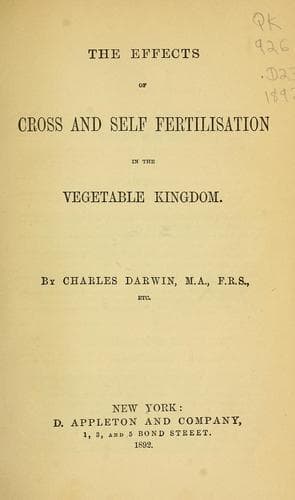
The Effects of Cross & Self-Fertilisation in the Vegetable KingdomDarwin, Charles
Science
The Effects of Cross & Self-Fertilisation in the Vegetable Kingdom
Darwin, Charles
Fertilization of plants; Plants -- Variation; Pollination
The average height of the flower-stems on the twenty-five crossed plants
in all the pots taken together is 43.12 inches, and that of the
twenty-five self-fertilised plants 39.82, or as 100 to 92. In order to
test this result, the plants planted in pairs in Pots 1 and 8 were
considered by themselves, and the average height of the sixteen crossed
plants is here 44.9, and that of the sixteen self-fertilised plants
42.03, or as 100 to 94. Again, the plants raised from the thickly sown
seed in Pots 9 and 10, which were subjected to very severe mutual
competition, were taken by themselves, and the average height of the
nine crossed plants is 39.86, and that of the nine self-fertilised
plants 35.88, or as 100 to 90. The plants in these two latter pots (9
and 10), after being measured, were cut down close to the ground and
weighed: the nine crossed plants weighed 57.66 ounces, and the nine
self-fertilised plants 45.25 ounces, or as 100 to 78. On the whole we
may conclude, especially from the evidence of weight, that seedlings
from a cross between flowers on the same plant have a decided, though
not great, advantage over those from flowers fertilised with their own
pollen, more especially in the case of the plants subjected to severe
mutual competition. But the advantage is much less than that exhibited
by the crossed offspring of distinct plants, for these exceeded the
self-fertilised plants in height as 100 to 70, and in the number of
flower-stems as 100 to 48. Digitalis thus differs from Ipomoea, and
almost certainly from Mimulus, as with these two species a cross between
flowers on the same plant did no good.
CALCEOLARIA.
A BUSHY GREENHOUSE VARIETY, WITH YELLOW FLOWERS BLOTCHED WITH PURPLE.
The flowers in this genus are constructed so as to favour or almost
ensure cross-fertilisation (3/6. Hildebrand as quoted by H. Muller ‘Die
Befruchtung der Blumen’ 1873 page 277.); and Mr. Anderson remarks that
extreme care is necessary to exclude insects in order to preserve any
kind true. (3/7. ‘Gardeners’ Chronicle’ 1853 page 534.) He adds the
interesting statement, that when the corolla is cut quite away, insects,
as far as he has seen, never discover or visit the flowers. This plant
is, however, self-fertile if insects are excluded. So few experiments
were made by me, that they are hardly worth giving. Crossed and
self-fertilised seeds were sown on opposite sides of a pot, and after a
time the crossed seedlings slightly exceeded the self-fertilised in
height. When a little further grown, the longest leaves on the former
were very nearly 3 inches in length, whilst those on the self-fertilised
plants were only 2 inches. Owing to an accident, and to the pot being
too small, only one plant on each side grew up and flowered; the crossed
plant was 19 1/2 inches in height, and the self-fertilised one 15
inches; or as 100 to 77.
Linaria vulgaris.
Public-domain text, read in full here on John Shaqi.
Reviews
Reviews
No reviews yet
Be the first to share your thoughts on this work.
Elsewhere in the archive
Join the Discussion
Join the discussion
Sign in to leave a comment or review.
Sign InorCreate an account