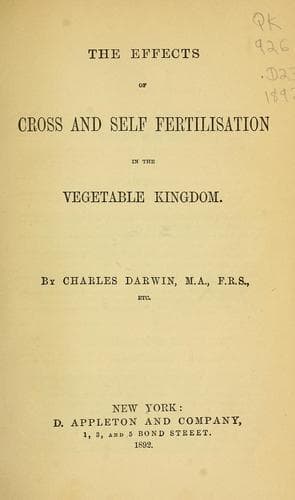
The Effects of Cross & Self-Fertilisation in the Vegetable KingdomDarwin, Charles
Science
The Effects of Cross & Self-Fertilisation in the Vegetable Kingdom
Darwin, Charles
Fertilization of plants; Plants -- Variation; Pollination
It has been mentioned in the introductory chapter that two large beds of
this plant were raised by me many years ago from crossed and
self-fertilised seeds, and that there was a conspicuous difference in
height and general appearance between the two lots. The trial was
afterwards repeated with more care; but as this was one of the first
plants experimented on, my usual method was not followed. Seeds were
taken from wild plants growing in this neighbourhood and sown in poor
soil in my garden. Five plants were covered with a net, the others being
left exposed to the bees, which incessantly visit the flowers of this
species, and which, according to H. Muller, are the exclusive
fertilisers. This excellent observer remarks that, as the stigma lies
between the anthers and is mature at the same time with them,
self-fertilisation is possible. (3/8. ‘Die Befruchtung’ etc. page 279.)
But so few seeds are produced by protected plants, that the pollen and
stigma of the same flower seem to have little power of mutual
interaction. The exposed plants bore numerous capsules forming solid
spikes. Five of these capsules were examined and appeared to contain an
equal number of seeds; and these being counted in one capsule, were
found to be 166. The five protected plants produced altogether only
twenty-five capsules, of which five were much finer than all the others,
and these contained an average of 23.6 seeds, with a maximum in one
capsule of fifty-five. So that the number of seeds in the capsules on
the exposed plants to the average number in the finest capsules on the
protected plants was as 100 to 14.
Some of the spontaneously self-fertilised seeds from under the net, and
some seeds from the uncovered plants naturally fertilised and almost
certainly intercrossed by the bees, were sown separately in two large
pots of the same size; so that the two lots of seedlings were not
subjected to any mutual competition. Three of the crossed plants when in
full flower were measured, but no care was taken to select the tallest
plants; their heights were 7 4/8, 7 2/8, and 6 4/8 inches; averaging
7.08 in height. The three tallest of all the self-fertilised plants were
then carefully selected, and their heights were 6 3/8, 5 5/8, and 5 2/8,
averaging 5.75 in height. So that the naturally crossed plants were to
the spontaneously self-fertilised plants in height, at least as much as
100 to 81.
Verbascum thapsus.
Public-domain text, read in full here on John Shaqi.
Reviews
Reviews
No reviews yet
Be the first to share your thoughts on this work.
Elsewhere in the archive
Join the Discussion
Join the discussion
Sign in to leave a comment or review.
Sign InorCreate an account