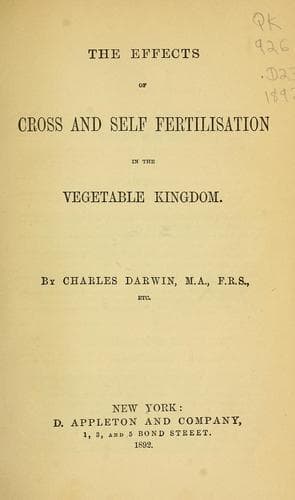
The Effects of Cross & Self-Fertilisation in the Vegetable KingdomDarwin, Charles
Science
The Effects of Cross & Self-Fertilisation in the Vegetable Kingdom
Darwin, Charles
Fertilization of plants; Plants -- Variation; Pollination
It appears from Hildebrand’s description (‘Botanische Zeitung’ 1867 page
285) that the conspicuous flowers of this plant are adapted for
cross-fertilisation. Seedlings were twice raised from purchased seed;
but during the early summer, when first experimented on, they were
extremely sterile, many of the anthers containing hardly any pollen.
Nevertheless, during the autumn these same plants spontaneously produced
a good many seeds. Twenty-six flowers during the two years were crossed
with pollen from a distinct plant, but they yielded only eleven
capsules; and these contained very few seeds! Twenty-eight flowers were
fertilised with pollen from the same flower, and these yielded only ten
capsules, which, however, contained rather more seed than the crossed
capsules. Eight pairs of germinating seeds were planted on opposite
sides of five pots; and exactly half the crossed and half the
self-fertilised plants exceeded their opponents in height. Two of the
self-fertilised plants died young, before they were measured, and their
crossed opponents were thrown away. The six remaining pairs of these
grew very unequally, some, both of the crossed and self-fertilised
plants, being more than twice as tall as the others. The average height
of the crossed plants was 60 inches, and that of the self-fertilised
plants 65 inches, or as 100 to 108. A cross, therefore, between distinct
individuals here appears to do no good; but this result deduced from so
few plants in a very sterile condition and growing very unequally,
obviously cannot be trusted.]
CHAPTER IV.
CRUCIFERAE, PAPAVERACEAE, RESEDACEAE, ETC.
Brassica oleracea, crossed and self-fertilised plants.
Great effect of a cross with a fresh stock on the weight of the
offspring.
Iberis umbellata.
Papaver vagum.
Eschscholtzia californica, seedlings from a cross with a fresh stock not
more vigorous, but more fertile than the self-fertilised seedlings.
Reseda lutea and odorata, many individuals sterile with their own pollen.
Viola tricolor, wonderful effects of a cross.
Adonis aestivalis.
Delphinium consolida.
Viscaria oculata, crossed plants hardly taller, but more fertile than
the self-fertilised.
Dianthus caryophyllus, crossed and self-fertilised plants compared for
four generations.
Great effects of a cross with a fresh stock.
Uniform colour of the flowers on the self-fertilised plants.
Hibiscus africanus.
[6. CRUCIFERAE.--Brassica oleracea.
VAR. CATTELL’S EARLY BARNES CABBAGE.
Public-domain text, read in full here on John Shaqi.
Reviews
Reviews
No reviews yet
Be the first to share your thoughts on this work.
Elsewhere in the archive
Join the Discussion
Join the discussion
Sign in to leave a comment or review.
Sign InorCreate an account