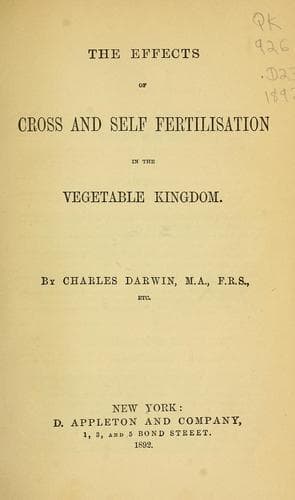
The Effects of Cross & Self-Fertilisation in the Vegetable KingdomDarwin, Charles
Science
The Effects of Cross & Self-Fertilisation in the Vegetable Kingdom
Darwin, Charles
Fertilization of plants; Plants -- Variation; Pollination
The flowers of the common cabbage are adapted, as shown by H. Muller,
for cross-fertilisation, and should this fail, for self-fertilisation.
(4/1. ‘Die Befruchtung’ etc. page 139.) It is well known that the
varieties are crossed so largely by insects, that it is impossible to
raise pure kinds in the same garden, if more than one kind is in flower
at the same time. Cabbages, in one respect, were not well fitted for my
experiments, as, after they had formed heads, they were often difficult
to measure. The flower-stems also differ much in height; and a poor
plant will sometimes throw up a higher stem than that of a fine plant.
In the later experiments, the fully-grown plants were cut down and
weighed, and then the immense advantage from a cross became manifest.
A single plant of the above variety was covered with a net just before
flowering, and was crossed with pollen from another plant of the same
variety growing close by; and the seven capsules thus produced contained
on an average 16.3 seeds, with a maximum of twenty in one capsule. Some
flowers were artificially self-fertilised, but their capsules did not
contain so many seeds as those from flowers spontaneously
self-fertilised under the net, of which a considerable number were
produced. Fourteen of these latter capsules contained on an average 4.1
seeds, with a maximum in one of ten seeds; so that the seeds in the
crossed capsules were in number to those in the self-fertilised capsules
as 100 to 25. The self-fertilised seeds, fifty-eight of which weighed
3.88 grains, were, however, a little finer than those from the crossed
capsules, fifty-eight of which weighed 3.76 grains. When few seeds are
produced, these seem often to be better nourished and to be heavier than
when many are produced.
The two lots of seeds in an equal state of germination were planted,
some on opposite sides of a single pot, and some in the open ground. The
young crossed plants in the pot at first exceeded by a little in height
the self-fertilised; then equalled them; were then beaten; and lastly
were again victorious. The plants, without being disturbed, were turned
out of the pot, and planted in the open ground; and after growing for
some time, the crossed plants, which were all of nearly the same height,
exceeded the self-fertilised ones by 2 inches. When they flowered, the
flower-stems of the tallest crossed plant exceeded that of the tallest
self-fertilised plant by 6 inches. The other seedlings which were
planted in the open ground stood separate, so that they did not compete
with one another; nevertheless the crossed plants certainly grew to a
rather greater height than the self-fertilised; but no measurements were
made. The crossed plants which had been raised in the pot, and those
planted in the open ground, all flowered a little before the
self-fertilised plants.
CROSSED AND SELF-FERTILISED PLANTS OF THE SECOND GENERATION.
Public-domain text, read in full here on John Shaqi.
Reviews
Reviews
No reviews yet
Be the first to share your thoughts on this work.
Elsewhere in the archive
Join the Discussion
Join the discussion
Sign in to leave a comment or review.
Sign InorCreate an account