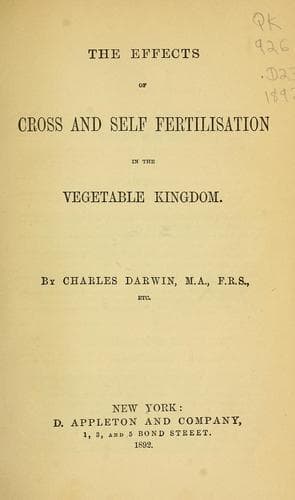
The Effects of Cross & Self-Fertilisation in the Vegetable KingdomDarwin, Charles
Science
The Effects of Cross & Self-Fertilisation in the Vegetable Kingdom
Darwin, Charles
Fertilization of plants; Plants -- Variation; Pollination
The average height of the thirty crossed plants is here 17.34, and that
of the twenty-nine self-fertilised plants (one having died) 15.51, or as
100 to 89. I am surprised that the difference did not prove somewhat
greater, considering that in the last experiment it was as 100 to 86;
but this latter ratio, as before explained, was probably too great. It
should, however, be observed that in the last experiment (Table 4/31),
the crossed plants competed with plants of the third self-fertilised
generation; whilst in the present case, plants derived from a cross with
a fresh stock competed with self-fertilised plants of the first
generation.
The crossed plants in the present case, as in the last, were more
fertile than the self-fertilised, both lots being left uncovered in the
greenhouse. The thirty crossed plants produced 103 seed-bearing
flowers-heads, as well as some heads which yielded no seeds; whereas the
twenty-nine self-fertilised plants produced only 81 seed-bearing heads;
therefore thirty such plants would have produced 83.7 heads. We thus get
the ratio of 100 to 81, for the number of seed-bearing flower-heads
produced by the crossed and self-fertilised plants. Moreover, a number
of seed-bearing heads from the crossed plants, compared with the same
number from the self-fertilised, yielded seeds by weight, in the ratio
of 100 to 92. Combining these two elements, namely, the number of
seed-bearing heads and the weight of seeds in each head, the
productiveness of the crossed to the self-fertilised plants was as 100
to 75.
The crossed and self-fertilised seeds, which remained after the above
pairs had been planted, (some in a state of germination and some not
so), were sown early in the year out of doors in two rows. Many of the
self-fertilised seedlings suffered greatly, and a much larger number of
them perished than of the crossed. In the autumn the surviving
self-fertilised plants were plainly less well-grown than the crossed
plants.
7. PAPAVERACEAE.--Papaver vagum.
A SUB-SPECIES OF Papaver dubium, FROM THE SOUTH OF FRANCE.
Public-domain text, read in full here on John Shaqi.
Reviews
Reviews
No reviews yet
Be the first to share your thoughts on this work.
Elsewhere in the archive
Join the Discussion
Join the discussion
Sign in to leave a comment or review.
Sign InorCreate an account