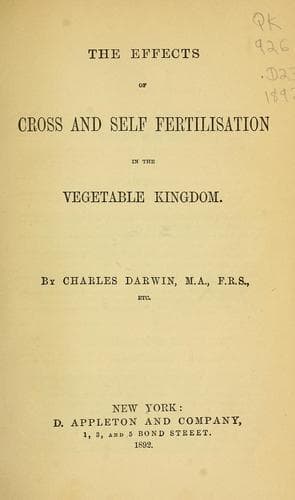
The Effects of Cross & Self-Fertilisation in the Vegetable KingdomDarwin, Charles
Science
The Effects of Cross & Self-Fertilisation in the Vegetable Kingdom
Darwin, Charles
Fertilization of plants; Plants -- Variation; Pollination
The poppy does not secrete nectar, but the flowers are highly
conspicuous and are visited by many pollen-collecting bees, flies and
beetles. The anthers shed their pollen very early, and in the case of
Papaver rhoeas, it falls on the circumference of the radiating stigmas,
so that this species must often be self-fertilised; but with Papaver
dubium the same result does not follow (according to H. Muller ‘Die
Befruchtung’ page 128), owing to the shortness of the stamens, unless
the flower happens to stand inclined. The present species, therefore,
does not seem so well fitted for self-fertilisation as most of the
others. Nevertheless Papaver vagum produced plenty of capsules in my
garden when insects were excluded, but only late in the season. I may
here add that Papaver somniferum produces an abundance of spontaneously
self-fertilised capsules, as Professor H. Hoffmann likewise found to be
the case. (4/2. ‘Zur Speciesfrage’ 1875 page 53.) Some species of
Papaver cross freely when growing in the same garden, as I have known to
be the case with Papaver bracteatum and orientale.
Plants of Papaver vagum were raised from seeds sent me from Antibes
through the kindness of Dr. Bornet. Some little time after the flowers
had expanded, several were fertilised with their own pollen, and others
(not castrated) with pollen from a distinct individual; but I have
reason to believe, from observations subsequently made, that these
flowers had been already fertilised by their own pollen, as this process
seems to take place soon after their expansion. (4/3. Mr. J. Scott found
‘Report on the Experimental Culture of the Opium Poppy’ Calcutta 1874
page 47, in the case of Papaver somniferum, that if he cut away the
stigmatic surface before the flower had expanded, no seeds were
produced; but if this was done “on the second day, or even a few hours
after the expansion of the flower on the first day, a partial
fertilisation had already been effected, and a few good seeds were
almost invariably produced.” This proves at how early a period
fertilisation takes place.) I raised, however, a few seedlings of both
lots, and the self-fertilised rather exceeded the crossed plants in
height.
Early in the following year I acted differently, and fertilised seven
flowers, very soon after their expansion, with pollen from another
plant, and obtained six capsules. From counting the seeds in a
medium-sized one, I estimated that the average number in each was at
least 120. Four out of twelve capsules, spontaneously self-fertilised at
the same time, were found to contain no good seeds; and the remaining
eight contained on an average 6.6 seeds per capsule. But it should be
observed that later in the season the same plants produced under a net
plenty of very fine spontaneously self-fertilised capsules.
Public-domain text, read in full here on John Shaqi.
Reviews
Reviews
No reviews yet
Be the first to share your thoughts on this work.
Elsewhere in the archive
Join the Discussion
Join the discussion
Sign in to leave a comment or review.
Sign InorCreate an account