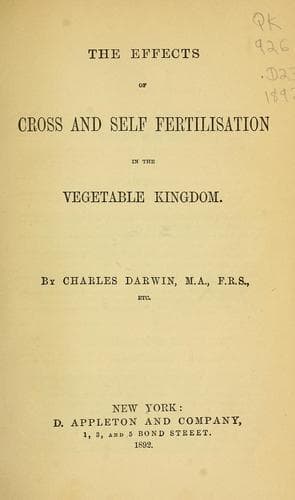
The Effects of Cross & Self-Fertilisation in the Vegetable KingdomDarwin, Charles
Science
The Effects of Cross & Self-Fertilisation in the Vegetable Kingdom
Darwin, Charles
Fertilization of plants; Plants -- Variation; Pollination
Fritz Muller sent me from South Brazil seeds of plants which were there
absolutely sterile when fertilised with pollen from the same plant, but
were perfectly fertile when fertilised with pollen from any other plant.
The plants raised by me in England from these seeds were examined by
Professor Asa Gray, and pronounced to belong to E. Californica, with
which they were identical in general appearance. Two of these plants
were covered by a net, and were found not to be so completely
self-sterile as in Brazil. But I shall recur to this subject in another
part of this work. Here it will suffice to state that eight flowers on
these two plants, fertilised with pollen from another plant under the
net, produced eight fine capsules, each containing on an average about
eighty seeds. Eight flowers on these same plants, fertilised with their
own pollen, produced seven capsules, which contained on an average only
twelve seeds, with a maximum in one of sixteen seeds. Therefore the
cross-fertilised capsules, compared with the self-fertilised, yielded
seeds in the ratio of about 100 to 15. These plants of Brazilian
parentage differed also in a marked manner from the English plants in
producing extremely few spontaneously self-fertilised capsules under a
net.
Crossed and self-fertilised seeds from the above plants, after
germinating on bare sand, were planted in pairs on the opposite sides of
five large pots. The seedlings thus raised were the grandchildren of the
plants which grew in Brazil; the parents having been grown in England.
As the grandparents in Brazil absolutely require cross-fertilisation in
order to yield any seeds, I expected that self-fertilisation would have
proved very injurious to these seedlings, and that the crossed ones
would have been greatly superior in height and vigour to those raised
from self-fertilised flowers. But the result showed that my anticipation
was erroneous; for as in the last experiment with plants of the English
stock, so in the present one, the self-fertilised plants exceeded the
crossed by a little in height. It will be sufficient to state that the
fourteen crossed plants averaged 44.64, and the fourteen self-fertilised
45.12 inches in height; or as 100 to 101.
THE EFFECTS OF A CROSS WITH A FRESH STOCK.
I now tried a different experiment. Eight flowers on the self-fertilised
plants of the last experiment (i.e., grandchildren of the plants which
grew in Brazil) were again fertilised with pollen from the same plant,
and produced five capsules, containing on an average 27.4 seeds, with a
maximum in one of forty-two seeds. The seedlings raised from these seeds
formed the second SELF-FERTILISED generation of the Brazilian stock.
Public-domain text, read in full here on John Shaqi.
Reviews
Reviews
No reviews yet
Be the first to share your thoughts on this work.
Elsewhere in the archive
Join the Discussion
Join the discussion
Sign in to leave a comment or review.
Sign InorCreate an account