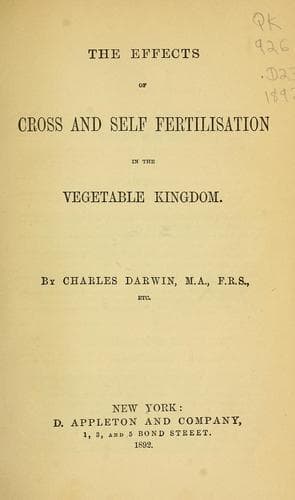
The Effects of Cross & Self-Fertilisation in the Vegetable KingdomDarwin, Charles
Science
The Effects of Cross & Self-Fertilisation in the Vegetable Kingdom
Darwin, Charles
Fertilization of plants; Plants -- Variation; Pollination
Eight flowers on one of the crossed plants of the last experiment were
crossed with pollen from another grandchild, and produced five capsules.
These contained on an average 31.6 seeds, with a maximum in one of
forty-nine seeds. The seedlings raised from these seeds may be called
the INTERCROSSED.
Lastly, eight other flowers on the crossed plants of the last experiment
were fertilised with pollen from a plant of the English stock, growing
in my garden, and which must have been exposed during many previous
generations to very different conditions from those to which the
Brazilian progenitors of the mother-plant had been subjected. These
eight flowers produced only four capsules, containing on an average 63.2
seeds, with a maximum in one of ninety. The plants raised from these
seeds may be called the ENGLISH-CROSSED. As far as the above averages
can be trusted from so few capsules, the English-crossed capsules
contained twice as many seeds as the intercrossed, and rather more than
twice as many as the self-fertilised capsules. The plants which yielded
these capsules were grown in pots in the greenhouse, so that their
absolute productiveness must not be compared with that of plants growing
out of doors.
The above three lots of seeds, namely, the self-fertilised,
intercrossed, and English-crossed, were planted in an equal state of
germination (having been as usual sown on bare sand) in nine large pots,
each divided into three parts by superficial partitions. Many of the
self-fertilised seeds germinated before those of the two crossed lots,
and these were of course rejected. The seedlings thus raised are the
great-grandchildren of the plants which grew in Brazil. When they were
from 2 to 4 inches in height, the three lots were equal. They were
measured when four-fifths grown, and again when fully grown, and as
their relative heights were almost exactly the same at these two ages, I
will give only the last measurements. The average height of the nineteen
English-crossed plants was 45.92 inches; that of the eighteen
intercrossed plants (for one died), 43.38; and that of the nineteen
self-fertilised plants, 50.3 inches. So that we have the following
ratios in height:--
The English-crossed to the self-fertilised plants, as 100 to 109.
The English-crossed to the intercrossed plants, as 100 to 94.
The intercrossed to the self-fertilised plants, as 100 to 116.
After the seed-capsules had been gathered, all these plants were cut
down close to the ground and weighed. The nineteen English crossed
plants weighed 18.25 ounces; the intercrossed plants (with their weight
calculated as if there had been nineteen) weighed 18.2 ounces; and the
nineteen self-fertilised plants, 21.5 ounces. We have therefore for the
weights of the three lots of plants the following ratios:--
The English-crossed to the self-fertilised plants, as 100 to 118.
The English-crossed to the intercrossed plants, as 100 to 100.
Public-domain text, read in full here on John Shaqi.
Reviews
Reviews
No reviews yet
Be the first to share your thoughts on this work.
Elsewhere in the archive
Join the Discussion
Join the discussion
Sign in to leave a comment or review.
Sign InorCreate an account