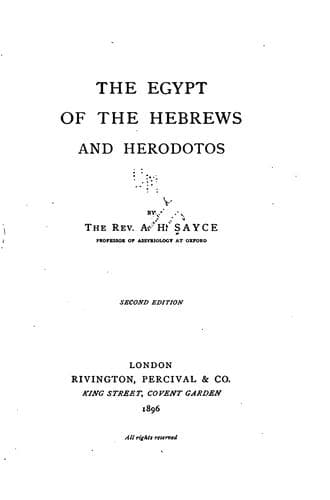
The Egypt of the Hebrews and HerodotosSayce, A. H. (Archibald Henry)
History
The Egypt of the Hebrews and Herodotos
Sayce, A. H. (Archibald Henry)
Egypt -- History, Ancient
There is a reason for thinking that such was the case. The story of Krôphi
and Môphi, in spite of the suspicions of Herodotos, is remarkably correct;
even the name of Krôphi has not undergone a greater amount of
transformation than it might have done if Herodotos had written it down
himself from the scribe’s mouth. It is the Egyptian Qerti or Qoriti, “the
two holes” out of which Egyptian mythology supposed Hâpi, the Nile-god, to
emerge at the period of the inundation. The Qerti were at the foot of the
granite peaks of Senem, the island of Bigeh, and of the opposite cliff on
the southern side of the First Cataract. We can almost fix the exact spot
where one of these Qerti was believed to have been. On the western bank of
Philæ, immediately facing Bigeh, is a portal built in the reign of
Hadrian, on the inner north wall of which is a picture of it. We see the
granite blocks of Bigeh piled one upon the other up to the summit of the
island where Mut the divine mother, and Horus the saviour, sit and keep
watch over the waters of the southern Nile. Below is the cavern, encircled
by a guardian serpent, within which the Nile-god is crouched, pouring from
a vase in either hand the waters of the river. Though in certain points
Herodotos has misunderstood his informant, on the whole the story of
Krôphi and Môphi is a fairly accurate page from the volume of Egyptian
mythology. Even the jingling Môphi may be derived from the Egyptian
_moniti_ or “mountains” between which the river ran, though Lauth may be
right in holding that Krôphi is Qer-Hâpi, “the hollow of the Nile,” and
Môphi Mu-Hâpi, “the waters of the Nile.”
But in one point the Greek historian has made a serious mistake. It was
not between Assuan and Elephantinê that the sources of the Nile were
placed, but between Bigeh and the mainland, on the other side of the
Cataract. Between Assuan and Elephantinê there are no “mountains,” only
the channel of the river. In saying therefore that Krôphi and Môphi were
mountains and that they rose between Syênê and Elephantinê, Herodotos
proves beyond all possibility of doubt that he had never been at the spot.
Had he actually visited Assuan the words of the sacred scribe would have
been reported more correctly.
Public-domain text, read in full here on John Shaqi.
Reviews
Reviews
No reviews yet
Be the first to share your thoughts on this work.
Elsewhere in the archive
Join the Discussion
Join the discussion
Sign in to leave a comment or review.
Sign InorCreate an account