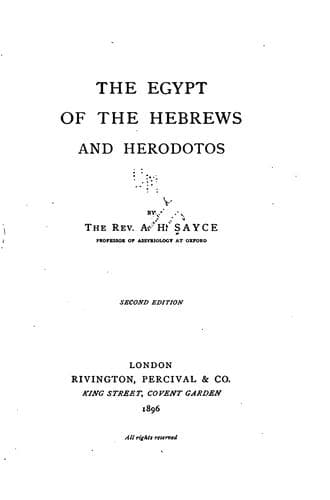
The Egypt of the Hebrews and HerodotosSayce, A. H. (Archibald Henry)
History
The Egypt of the Hebrews and Herodotos
Sayce, A. H. (Archibald Henry)
Egypt -- History, Ancient
Equally wide of the truth is what Herodotos has to tell us about the First
Cataract. Like other travellers to Egypt before and since he was anxious
to learn something about the sources of the Nile. But neither “the
Egyptians nor the Libyans nor the Greeks” whom he met could give him any
information. Perhaps had he sailed as far as Assuan some of the Ethiopians
who lived there might have been more communicative. At last, however, he
was introduced to one of the sacred scribes in the temple of Neit at
Sais—the only Egyptian priest, in fact, of higher rank, whom he seems to
have conversed with—and the scribe humoured the curiosity of the traveller
to the utmost of his desires, though even Herodotos suspected that he was
being made fun of. However, as in duty bound, he gravely writes down what
he was told. “Two mountains are there with pointed tops, between Syênê, a
city of the Thebais, and Elephantinê, which are called Krôphi and Môphi.
Out of the heart of these mountains flow the sources of the Nile, which
are bottomless, half the water running towards Egypt and the north, while
the other half goes to Ethiopia and the south. That the sources are
bottomless was proved by Psammetikhos, the king of Egypt, for after
letting down into them a rope several hundred thousand fathoms in length,
he did not find the bottom.” Herodotos adds that this was probably because
there were violent eddies in the water which carried the rope away.
Egyptian priests did not, as a rule, know Greek, and they avoided any kind
of intercourse with the “unclean” foreigner. Even to have conversed with
him would have caused pollution. Consequently “the priests” to whom
Herodotos so frequently alludes were merely the “beadles” of the day, who
took the tourist over the temples and showed him the principal objects of
interest. The sacred scribe of Sais was an exception to the general rule.
Since the days of Psammetikhos, Sais had been accustomed to Greek
visitors, and the prejudices against them were less strong there than in
other Egyptian towns. It is quite possible, therefore, that the scribe
whom Herodotos met was acquainted with the Greek language, and that no
dragoman was required to interpret his words.
Public-domain text, read in full here on John Shaqi.
Reviews
Reviews
No reviews yet
Be the first to share your thoughts on this work.
Elsewhere in the archive
Join the Discussion
Join the discussion
Sign in to leave a comment or review.
Sign InorCreate an account