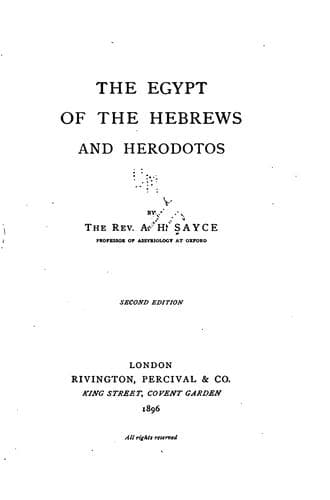
The Egypt of the Hebrews and HerodotosSayce, A. H. (Archibald Henry)
History
The Egypt of the Hebrews and Herodotos
Sayce, A. H. (Archibald Henry)
Egypt -- History, Ancient
The dynasties of Manetho were successive and not contemporaneous. This
fact was one of the main results of the excavations and discoveries of
Mariette Pasha. The old attempts to form artificial schemes of
chronology—which, however, satisfied no one but their authors—upon the
supposition that some of the dynasties reigned together are now
discredited for ever. Every fresh discovery made in Egypt, which adds to
our knowledge of ancient Egyptian history, makes the fact still more
certain. There were epochs, indeed, when more than one line of kings
claimed sway in the valley of the Nile, but when such was the case,
Manetho selected what he or his authorities considered the sole legitimate
dynasty, and disregarded every other. Of the two rival twenty-first
dynasties which the monuments have brought to light, the lists of Manetho
recognise but one, and the Assyrian rule in Egypt at a subsequent date is
ignored in favour of the princes of Sais who were reigning at the same
time.
If, then, any reliance is to be placed on the length of time ascribed to
the Hyksos dominion in the valley of the Nile, and if we are still to hold
to the old belief of Christendom and see in the Hebrew wanderer into Egypt
the Abram who contended against Chedor-laomer and the subject kings of
Babylonia, it would have been about two centuries after the settlement of
the Asiatic conquerors in the Delta that Abraham and Sarah arrived at
their court. The court was doubtless held at Zoan, the modern Sân. Here
was the Hyksos capital, and its proximity to the Asiatic frontier of Egypt
made it easy of access to a traveller from Palestine. We are told in the
Book of Numbers (xiii. 22) that Hebron was built seven years before Zoan
in Egypt; and it may be that the building here referred to was that which
caused Zoan to become the seat of the Hyksos power.
Asiatic migration into Egypt was no new thing. On the walls of one of the
tombs of Beni-Hassan there is pictured the arrival of thirty-seven Aamu or
Asiatics “of Shu,” in the sixth year of Usertesen II. of the twelfth
dynasty. Under the conduct of their chief, Ab-sha, they came from the
mountains of the desert, bringing with them gazelles as well as kohl for
the ladies of the court. Four women in long bright-coloured robes walk
between groups of bearded men, and two children are carried in a pannier
on a donkey’s back. The men are armed with bows, their feet are shod with
sandals, and they wear the vari-coloured garments for which the people of
Phœnicia were afterwards famed.
Public-domain text, read in full here on John Shaqi.
Reviews
Reviews
No reviews yet
Be the first to share your thoughts on this work.
Join the Discussion
Join the discussion
Sign in to leave a comment or review.
Sign InorCreate an account