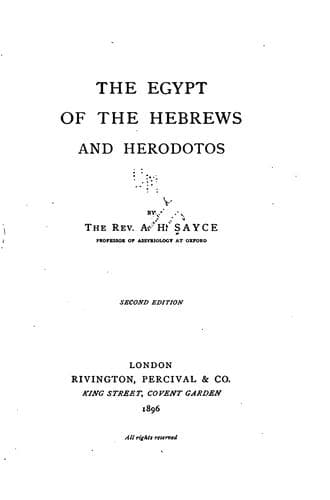
The Egypt of the Hebrews and HerodotosSayce, A. H. (Archibald Henry)
History
The Egypt of the Hebrews and Herodotos
Sayce, A. H. (Archibald Henry)
Egypt -- History, Ancient
Joseph, more fortunate than Bata, rose from his prison to the highest
office of state. The dreams, through which this was accomplished, were in
full keeping with the belief of the age. Dreams even to-day play an
important part in the popular faith of Egypt. In the days of the Pharaohs
it was the same. Thothmes IV. cleared away the sand that had overwhelmed
the Sphinx, and built a temple between its paws, in consequence of a dream
in which Ra-Harmakhis had appeared to him when, wearied with hunting, he
had lain down to sleep under the shadow of the ancient monument. A
thousand years later Nut-Amon of Ethiopia was summoned by a dream to march
into Egypt. In Greek days, when the temple of Abydos had fallen into ruin,
an oracle was established in one of its deserted chambers, and those who
consulted it received their answers in the “true dreams” that came to them
during the night. The dreams, however, needed at times an interpreter to
explain them, and of such an interpreter mention is made in a Greek
inscription from the Serapeum at Memphis. At other times the dreamer
himself could interpret his vision by the help of the books in which the
signification of dreams had been reduced to a science.
The dreams of Pharaoh and “his two eunuchs,” however, “the chief butler”
and “the chief baker,” were of a strange and novel kind, and there were no
books that could explain them. Even the “magicians” and “wise men” of
Egypt failed to understand the dream of Pharaoh. And yet, when the Hebrew
captive had pointed out its meaning, no doubt remained in the mind of
Pharaoh and his servants that he was right. From time immemorial the Nile
had been likened to a milch-cow, and the fertilising water which it spread
over the soil to the milk that sustains human life. The cow-headed goddess
Hathor or Isis watched over the fertility of Egypt. It was said of her
that she “caused the Nile to overflow at his due time,” and the “seven
great Hathors” were the seven forms under which she was worshipped. In the
seven kine, accordingly, which stood “upon the bank of the river” the
Egyptian readily saw the life-giving powers of the Nile.
It needed but the word of the Pharaoh to change the Hebrew slave into an
Egyptian ruler, second only to the monarch itself. His very name ceased to
be Semitic, and henceforth became Zaphnath-paaneah. He even allied himself
with the exclusive priesthood of Heliopolis or On, marrying Asenath, the
daughter of the priest of Ra. By name and marriage, as well as by
position, he was thus adopted into the ranks of the native aristocracy.
Public-domain text, read in full here on John Shaqi.
Reviews
Reviews
No reviews yet
Be the first to share your thoughts on this work.
Join the Discussion
Join the discussion
Sign in to leave a comment or review.
Sign InorCreate an account