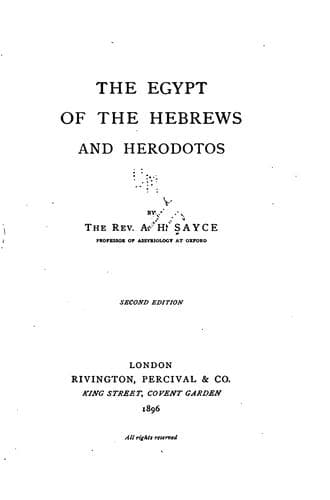
The Egypt of the Hebrews and Herodotos — John Shaqi
The Egypt of the Hebrews and HerodotosSayce, A. H. (Archibald Henry)
History
The Egypt of the Hebrews and Herodotos
Sayce, A. H. (Archibald Henry)
Egypt -- History, Ancient
Joseph must have entered Egypt when it was still under Hyksos domination.
The promise made to Abraham (Gen. xv. 13) is very explicit: “Know of a
surety that thy seed shall be a stranger in a land that is not theirs, and
shall serve them; and they shall afflict them four hundred years.” Equally
explicit is the statement of the book of Exodus (xii. 40, 41): “The
sojourning of the children of Israel who dwelt in Egypt was four hundred
and thirty years. And it came to pass at the end of the four hundred and
thirty years, even the self-same day it came to pass, that all the hosts
of the Lord went out from the land of Egypt.” Here thirty years—the length
of a generation—are added to the four hundred during which the Israelites
were to be afflicted in the land of the foreigner. If the Exodus took
place in the latter years of the nineteenth dynasty—-and, as we shall see,
the Egyptian monuments forbid our placing it elsewhere—the four hundred
and thirty years of the Biblical narrative bring us to the beginning of
the last Hyksos dynasty.
It is a curious fact that Egyptian history also knows of an epoch of four
hundred years which covers almost the same period as the four hundred
years of Genesis. Mariette Pasha, when excavating at Sân, the ancient
Zoan, found a stela which had been erected in the reign of Ramses II. by
one of his officers, the governor of the Asiatic frontier. The stela
commemorates a visit to Sân made by the governor, on the fourth day of the
month Mesori, in the four hundredth year of “the king of Upper and Lower
Egypt, Set-âa-pehti, the son of the Sun who loved him, also named
Set-Nubti.” Since Set or Sutekh was the god of the Hyksos, while Sân was
the Hyksos capital, it is clear that Set-âa-pehti or Set-Nubti was a
Hyksos prince who claimed rule over the whole of Egypt, and with whom a
Hyksos era commenced. Professor Maspero and Dr. de Cara consider the
prince in question to have been really the god Sutekh himself; this,
however, is not the natural interpretation of the titles assigned to him,
and it is not improbable that Professor Wiedemann is right in identifying
him with a certain Hyksos Pharaoh, Set-[Nub?]ti, mentioned on a monument
discovered by Mariette at Tel-Mokdam. This latter Pharaoh is entitled “the
good god, the star of Upper and Lower Egypt, the son of the Sun, beloved
by Sutekh, the lord of Avaris.”
Public-domain text, read in full here on John Shaqi.
Reviews
Reviews
No reviews yet
Be the first to share your thoughts on this work.
Join the Discussion
Join the discussion
Sign in to leave a comment or review.
Sign InorCreate an account