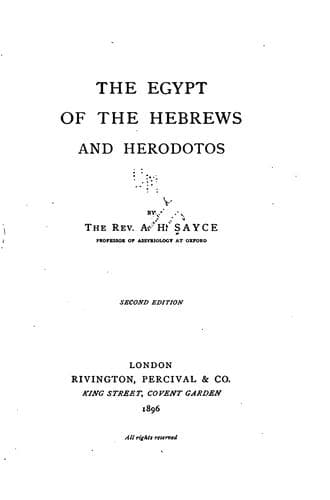
The Egypt of the Hebrews and HerodotosSayce, A. H. (Archibald Henry)
History
The Egypt of the Hebrews and Herodotos
Sayce, A. H. (Archibald Henry)
Egypt -- History, Ancient
Towards the northern side of it rose the palace of the Pharaoh, whose
ruins have been explored by Professor Flinders Petrie. It was one of the
most gorgeous edifices ever erected by man. The walls and columns were
inlaid with gold and bronze and stones of various colours, and adorned
with statuary and painting. Even the floors were frescoed; and, if we may
judge from the one discovered by Professor Petrie, the art was of the
highest order. The plants and animals and fish depicted on it are drawn
with a perfection and a truthfulness to nature which seem to belong to the
nineteenth century of our era rather than to the fifteenth century before
Christ.
The public offices of the government adjoined the palace, and around it
were the houses of the nobles and officers of the court. They too
reflected the gay and brilliant adornment of the royal palace, and their
walls were enlivened by frescoes, which represented the scenes of
every-day life. Among the public offices was the archive-chamber, to which
the documents of state had been transferred from Thebes, as well as the
foreign office, where scribes were busily engaged in correspondence with
the governors of the Asiatic provinces of the empire and the princes of
foreign states.
In the centre of the city rose the great temple of Aten, the solar disk,
the new object of the Pharaoh’s adoration. Though the name was Egyptian,
the deity and his cult were alike of Asiatic origin. The Aten, in fact, to
whom the temple had been reared, was the Asiatic Baal. He was the Sun-god,
whose visible manifestation was the solar disk. But it was a Sun-god who
was not only supreme over all other gods; they were absorbed into him, and
existed only in so far as he endowed them with divine life. It is thus
that Aten-Ra, the solar disk of the Sun-god, is addressed by the Pharaoh’s
queen: “Thou disk of the Sun, thou living god, there is none other beside
thee! Thou givest health to the eyes through thy beams, Creator of all
things!” One of Khu-n-Aten’s officers, on the walls of his tomb, speaks in
similar terms: “Thou, O god, who in truth art the living one, standest
before the two eyes. Thou art he which createst what never was, which
formest everything, which art in all things: we also have come into being
through the word of thy mouth.”
The new faith of Egypt was a combination of the worship of Baal with the
philosophic conceptions which had gathered round the worship of the
Egyptian Sun-god, Ra, at Heliopolis. The worship of Baal had lost its
grossness, and been refined into a form of monotheism. But the monotheism
was essentially pantheistic; there was, indeed, but one god to whom
adoration was paid, but he was universally diffused throughout nature. The
personal character of the Asiatic Baal seems to have disappeared in the
Aten worship of Egypt.
Public-domain text, read in full here on John Shaqi.
Reviews
Reviews
No reviews yet
Be the first to share your thoughts on this work.
Join the Discussion
Join the discussion
Sign in to leave a comment or review.
Sign InorCreate an account