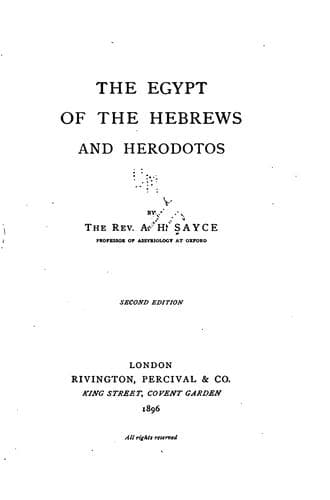
The Egypt of the Hebrews and HerodotosSayce, A. H. (Archibald Henry)
History
The Egypt of the Hebrews and Herodotos
Sayce, A. H. (Archibald Henry)
Egypt -- History, Ancient
When Khu-n-Aten was Pharaoh, the cities of Canaan were numerous and
wealthy. The people were highly cultured, and excelled especially as
workers in gold and silver, as manufacturers of porcelain and
vari-coloured glass, and as weavers of richly-dyed linen. Their merchants
already traded to distant parts of the known world. The governors
appointed by the Pharaoh were for the most part of native origin, and at
times a representative of the old line of kings was left among them,
though an Egyptian prefect was often placed at his side. The governors
were controlled by the presence of Egyptian garrisons, as well as by the
visits of an Egyptian “commissioner.” Their rivalries and quarrels form
the subject of many of the letters which have been found at Tel el-Amarna,
both sides appealing to the Pharaoh for protection and help, and alike
protesting their loyalty to him. It seems to have been the part of
Egyptian policy to encourage these quarrels, or at all events to hold an
even balance between the rival governors.
As long as the power of Egypt remained intact, _these quarrels_, which
sometimes _resulted in open war_, offered no cause for alarm. Egyptian
troops could always be sent to the scene of disturbance before it could
become dangerous. But in the troublous days of Khu-n-Aten’s reign, when
Egypt itself was restless and inclined for revolt, the position of affairs
was changed. The Egyptian forces were needed at home, and the Pharaoh was
compelled to turn a deaf ear to the piteous appeals that were made to him
for assistance. The enemies of Egyptian rule began to multiply and grow
powerful. In the south the Khabiri or “Confederates” threatened the
Egyptian domination; in the north, Amorite rebels intrigued with the
Hittites and with the kings of Naharaim and Babylonia, while in all parts
of Palestine the Sute or Bedouin were perpetually on the watch to take
advantage of the weakness of the government.
Public-domain text, read in full here on John Shaqi.
Reviews
Reviews
No reviews yet
Be the first to share your thoughts on this work.
Join the Discussion
Join the discussion
Sign in to leave a comment or review.
Sign InorCreate an account