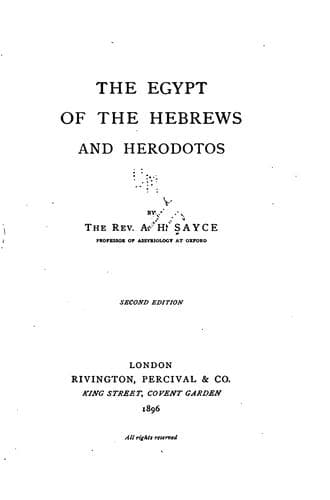
The Egypt of the Hebrews and HerodotosSayce, A. H. (Archibald Henry)
History
The Egypt of the Hebrews and Herodotos
Sayce, A. H. (Archibald Henry)
Egypt -- History, Ancient
face and the crown of Osiris, over whom is written the name of Akna-zapn,
or “Yakin of the North.” The monument is an evidence of a permanent
occupation of the country by the Egyptians, as the name and figure of the
god indicate that it was erected, not by the Egyptians themselves, but by
the Egyptianised natives of the land.
Along the Syrian coast Seti I. had already carried his arms. His campaigns
were followed by those of his son. Arvad, the shores of the Gulf of
Antioch, and even Cilicia, are enumerated among the conquests of the
Pharaoh. He even claims to have defeated the armies of Assyria, of Matena
or Mitanni, the Aram-Naharaim of Scripture, and of Singar in Mesopotamia.
At Luxor, on the western walls of the newly excavated court, we hear of
his having been at Tunip (now Tennib), “in the land of Naharaim,” of his
capture of a fortress of the Kati in the same district, and of how “the
Pharaoh” had taken a city in “the land of Satuna.” Satuna was one of those
countries in the far north whose name is never mentioned elsewhere in the
Egyptian texts.
The Syrian conquests, however, could never have been long in the Pharaoh’s
possession. Between them and Palestine lay the southern outposts of the
Hittite race. In the troublous times which followed the death of
Khu-n-Aten, the Hittites had overrun “the land of the Amorites” to the
north of Canaan, and fixed their southern capital in the holy city of
Kadesh, on the Orontes. It was a stronghold against which the forces of
Ramses were hurled in vain. For twenty years did the struggle continue
between the Pharaoh of Egypt and “the great king of the Hittites,” and at
last, exhausted by the long conflict, in which neither party had gained
the advantage, the two enemies agreed upon peace. A treaty was signed on
the twenty-first of the month Tybi, in the twenty-first year of the reign
of Ramses (B.C. 1327), “in the city of Ramses,” to which the Hittite
ambassadors had come. Ramses, on the one side, and Khita-sir, the son of
Mul-sir, the Hittite prince, on the other, bound themselves in it to
eternal friendship and alliance. In case of war they were to send troops
to one another’s help, and they agreed to put to death any criminals who
might fly from the one country to the other. Political offenders, however,
who had taken refuge in the territory of one or other of the two
contracting parties, were not to be injured. It was of course the
Canaanitish subjects of the Pharaoh, who adjoined the Hittite kingdom,
that were principally affected by these stipulations. It was further
determined that on no pretext whatever should any change be made in the
boundaries of the two monarchies. The treaty was placed under the
protection of the deities of Egypt and the Hittites, and a Hittite copy of
it was engraved on a silver plate. The agreement was cemented by the
marriage of Ramses to a daughter of the Hittite king, who thereupon
assumed an Egyptian name.
Public-domain text, read in full here on John Shaqi.
Reviews
Reviews
No reviews yet
Be the first to share your thoughts on this work.
Join the Discussion
Join the discussion
Sign in to leave a comment or review.
Sign InorCreate an account