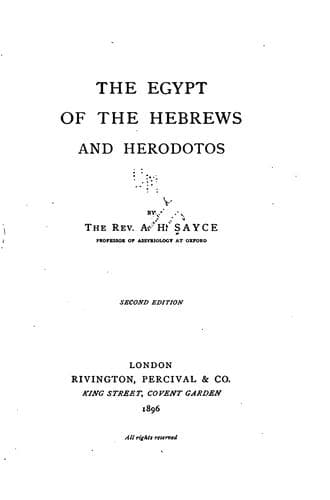
The Egypt of the Hebrews and HerodotosSayce, A. H. (Archibald Henry)
History
The Egypt of the Hebrews and Herodotos
Sayce, A. H. (Archibald Henry)
Egypt -- History, Ancient
The rest of Sheri’s tomb, so far as it has been preserved, is now in the
Gizeh Museum. Years after the inscription on the fragment at Oxford had
been deciphered, the hinder portion of the tomb was discovered by
Mariette. Like the lintel-stone in the Ashmolean Museum, it is adorned
with sculptures and hieroglyphics. Already, we learn from it, the
hieroglyphic system of writing was complete, the characters being used not
only to denote ideas and express syllables, but alphabetically as well.
The name of Send himself is spelt in the letters of the alphabet. The art
of the monument, though not equal to that which prevailed a few
generations later, is already advanced, while the texts show that the
religion and organisation of the empire were already old. In the age of
the second dynasty, at all events, we are far removed from the beginnings
of Egyptian civilisation.
With Snefru, the first king of the fourth dynasty, or, according to
another reckoning, the last king of the third, we enter upon the
monumental history of Egypt. Snefru’s monuments are to be found, not only
in Egypt, but also in the deserts of Sinai. There the mines of copper and
malachite were worked for him, and an Egyptian garrison kept guard upon
the Bedouin tribes. In Egypt, as has now been definitely proved by
Professor Petrie’s excavations, he built the pyramid of Medûm, one of the
largest and most striking of the pyramids. Around it were ranged the tombs
of his nobles and priests, from which have come some of the most beautiful
works of art in the Gizeh Museum.
The painted limestone statues of Ra-nefer and his wife Nefert, for
instance, are among the finest existing specimens of ancient Egyptian
workmanship. They are clearly life-like portraits, executed with a
delicacy and finish which might well excite the envy of a modern artist.
The character, and even the antecedents of the husband and wife, breathe
through their features. While in the one we can see the strong will and
solid common-sense of the self-made man, in the other can be traced the
culture and refinement of a royal princess.
Public-domain text, read in full here on John Shaqi.
Reviews
Reviews
No reviews yet
Be the first to share your thoughts on this work.
Join the Discussion
Join the discussion
Sign in to leave a comment or review.
Sign InorCreate an account