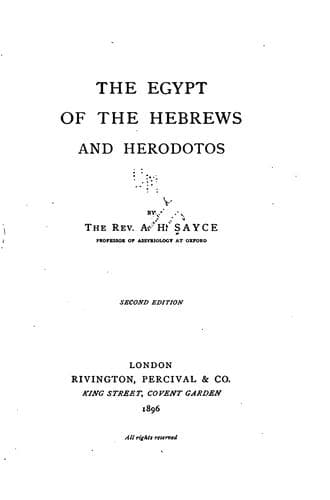
The Egypt of the Hebrews and HerodotosSayce, A. H. (Archibald Henry)
History
The Egypt of the Hebrews and Herodotos
Sayce, A. H. (Archibald Henry)
Egypt -- History, Ancient
Then came the long funeral procession bearing the corpse of Alexander from
Babylon to the tomb that was to be erected for him in his new city of
Alexandria. More than a year passed while it wound its way slowly from
city to city, till at last it arrived at Memphis. Here the body of the
great conqueror rested awhile until the gorgeous sepulchre was made ready
in which it was finally to repose.
It was plain that Ptolemy was aiming at independent power. Perdikkas, the
regent, accordingly attacked him, carrying in his train the young princes,
Philip Arridæus, and Alexander Ægos, the infant son of Alexander. But the
invading army was routed below Memphis, Perdikkas was slain, and the young
princes fell into the hands of the conqueror. From this time forward,
Ptolemy, though nominally a subject, acted as if he were a king.
Nikanôr was sent into Syria to annex it to Egypt. Jerusalem alone resisted
the invaders, but it was assaulted on the Sabbath when the defenders
withdrew from the walls, and all further opposition was at end. Palestine
and Cœle-Syria were again united with the kingdom on the Nile.
The union, however, did not last long. In B.C. 315 Philip Arridæus was
murdered, and Alexander was proclaimed successor to his empty dignity. The
year following, Antigonus, the rival of Ptolemy in Asia Minor, made ready
to invade Egypt. But Ptolemy had already conquered Kyrênê and Cyprus, and
was master of the sea. Syria and Palestine, however, submitted to
Antigonus, and though Ptolemy gained a decisive victory over his enemies
at Gaza, he did not think it prudent to pursue it. He contented himself,
therefore, with razing the fortifications of Acre and Jaffa, of Samaria
and Gaza.
In B.C. 312 the generals of Alexander, who still called themselves the
lieutenants of his son, came to a general agreement, each keeping that
portion of the empire which he had made his own. The agreement was almost
immediately followed by the murder of Alexander Ægos. Cleopatra, the
sister of the great Alexander, and his niece Thessalonika alone remained
of the royal family, and Cleopatra, on her way to Egypt to marry Ptolemy,
was assassinated by Antigonus (in B.C. 308), and Alexander’s niece soon
afterwards shared the same fate. The family of “the son of Ammon,” the
annihilator of the Persian Empire, was extinct.
Two years later, in B.C. 306, an end was put to the farce so long played
by the generals of Alexander, and each of them assumed the title of king.
Ptolemy took that of “king of Egypt.” To this the Greeks afterwards added
the name of Sôtêr, “Saviour,” when his supplies of corn had saved the
Rhodians from destruction during their heroic defence of their city
against the multitudinous war-ships of Antigonus.
Public-domain text, read in full here on John Shaqi.
Reviews
Reviews
No reviews yet
Be the first to share your thoughts on this work.
Elsewhere in the archive
Join the Discussion
Join the discussion
Sign in to leave a comment or review.
Sign InorCreate an account