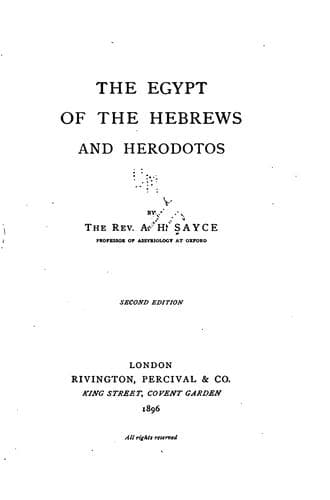
The Egypt of the Hebrews and HerodotosSayce, A. H. (Archibald Henry)
History
The Egypt of the Hebrews and Herodotos
Sayce, A. H. (Archibald Henry)
Egypt -- History, Ancient
Throughout his rule, Ptolemy never forgot the needs and interests of the
kingdom over which he ruled. Alexandria was completed, with its unrivalled
harbours, its stately public buildings, its broad quays and its spacious
streets. From first to last it remained the Greek capital of Egypt. It was
Greek in its origin, Greek in its architecture, Greek in its population;
Greek also in its character, its manners, and its faith. Cut off from the
rest of Egypt by the Mareotic Lake, and enjoying a European climate, it
was from its foundation what it is to-day, a city of Europe rather than of
Egypt. From it, as from an impregnable watch-tower, the Ptolemies directed
the fortunes of their kingdom: it was not only the key to Egypt, it was
also a bridle upon it. The wealth of the world passed through its streets
and harbours; the religions and philosophies of East and West met within
its halls. Ptolemy had founded in it a university, a prototype of Oxford
and Cambridge in modern England, of the Azhar in modern Cairo. In the
Museum, as it was called, a vast library was gathered together, and its
well-endowed chairs were filled with learned professors from all parts of
the Greek world, who wrote books and delivered lectures and dined together
at the royal charge.
But the Greeks were not the only inhabitants of the new city. The Jews
also settled there in large numbers on the eastern side of the town,
attracted by the offers of Ptolemy and the belief that the rising centre
of trade would be better worth inhabiting than the wasted fields of
Palestine. All the rights of Greek citizenship were granted to them, and
they were placed on a footing almost of equality with Ptolemy’s own
countrymen.
The native Egyptians were far worse treated. They had become “the hewers
of wood and carriers of water” for their new Greek masters. It was they
who furnished the government with its revenue, but in return they
possessed no rights, no privileges. When land was wanted for the veterans
of the Macedonian army, as, for example, in the Fayyûm, it was taken from
them without compensation. Taxes, ever heavier and heavier, were laid upon
them; and every attempt at remonstrance or murmuring was visited with
immediate punishment. The Egyptian had no rights unless he could be
registered a citizen of Alexandria, and this it was next to impossible for
him to be.
Public-domain text, read in full here on John Shaqi.
Reviews
Reviews
No reviews yet
Be the first to share your thoughts on this work.
Elsewhere in the archive
Join the Discussion
Join the discussion
Sign in to leave a comment or review.
Sign InorCreate an account