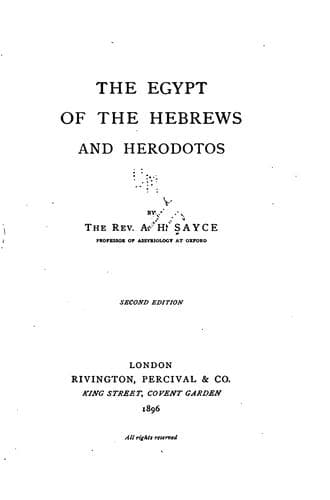
The Egypt of the Hebrews and HerodotosSayce, A. H. (Archibald Henry)
History
The Egypt of the Hebrews and Herodotos
Sayce, A. H. (Archibald Henry)
Egypt -- History, Ancient
The literature of Coptic Christianity was almost wholly religious. Little
else had an interest for the devoted adherents of the new faith. The
romances which had delighted their forefathers were replaced by legends of
the saints and martyrs, and Christian hymns succeeded to the poems of the
past. We owe to this passion for theology the preservation of productions
of the Jewish and Christian Churches which would otherwise have been lost.
The Book of Enoch, quoted though it is by St. Jude, would have perished
irrevocably had it not been for Coptic Christianity. The Church of
Abyssinia, a daughter of that of Egypt, has preserved it in an Ethiopic
translation, and portions of the Greek original from which the translation
was made have been found in a tomb at Ekhmîm, which was excavated in 1886.
It has long been known that the text used by the Abyssinian translator
must have differed considerably from that of which extracts have been
preserved for us in the Epistle of St. Jude and the writings of the
Byzantine historians Kedrenos and George the Syncellus; the
newly-discovered fragments now enable us to see what this text actually
was like. If the original book was written in Aramaic it would seem that
at least two authorised Greek versions of it existed, one of which was
used in Europe and Syria, the other in Egypt. Which was the older and more
faithful we have yet to learn.
The excavations at Ekhmîm have brought to light fragments of two other
works, both belonging to the early days of Christianity and long since
lost. One of these is supposed by its first editor, M. Bouriant, to be the
Apocalypse of St. Peter; it opens with an account of the Transfiguration,
which is followed by a vision of heaven and hell. The book appears to have
been composed or interpolated by a Gnostic, as there is a reference in it
to “the Æon” in which Moses and Elias dwelt in glory. The other work is of
more importance. It is the Gospel known to the early Church as that of St.
Peter, and the portion which is preserved contains the narrative of the
Passion and Resurrection of Christ. Throughout the narrative the
responsibility for the death of our Lord is transferred from Pilate to the
Jews; when the guard who watched the tomb under the centurion Petronius
ran to tell Pilate of the resurrection they had witnessed, “grieving
greatly and saying: Truly he was the son of God”: he answered: “I am clean
of the blood of the son of God: I too thought he was so.” Docetic
tendencies, however, are observable in the Gospel: at all events the cry
of Christ on the cross is rendered, “My power, (my) power, thou hast
forsaken me!”
Public-domain text, read in full here on John Shaqi.
Reviews
Reviews
No reviews yet
Be the first to share your thoughts on this work.
Elsewhere in the archive
Join the Discussion
Join the discussion
Sign in to leave a comment or review.
Sign InorCreate an account