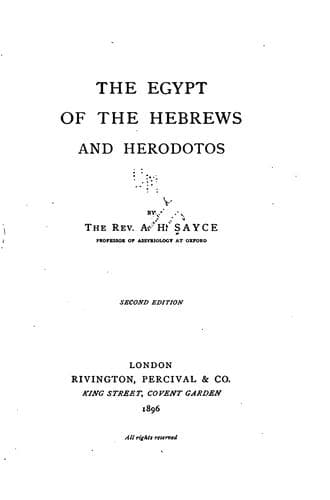
The Egypt of the Hebrews and HerodotosSayce, A. H. (Archibald Henry)
History
The Egypt of the Hebrews and Herodotos
Sayce, A. H. (Archibald Henry)
Egypt -- History, Ancient
What further discoveries of the lost documents of early Christianity still
await us in Egypt it is impossible to say. It is only during the last few
years that attention has been turned towards monuments which, to the
students of Egyptian antiquity, seemed of too recent a date. Countless
manuscripts of priceless value have already perished through the ignorance
of the _fellahin_ and the neglect of the tourist and _savan_, to whom the
term “Coptic” has been synonymous with “worthless.” But the soil of Egypt
is archæologically almost inexhaustible, and the land of the Septuagint,
of the Christian school of Alexandria, and of the passionate theology of a
later epoch, cannot fail to yield up other documents that will throw a
flood of light on the early history of our faith. It is only the other day
that, among the Fayyûm papyri now in the British Museum, there was found a
fragment of the Septuagint version of the Psalms older than the oldest MS.
of the Bible hitherto known. And the traveller who still wishes to see the
Nile at leisure and in his own way will find in the old Egyptian quarries
behind Dêr Abu Hannes, but a little to the south of the city which Hadrian
raised to the memory of Antinous, abundant illustrations of the doctrine
and worship of the primitive Coptic Church. He can there study all the
details of its ancient ecclesiastical architecture cut out of the living
rock, and can trace how the home of a hermit became first a place of
pilgrimage and then a chapel with its altar to the saints. The tombs
themselves, inscribed with the Greek epitaphs of the sainted fugitives
from persecution, still exist outside the caves in which they had dwelt.
We can even see the change taking place which transformed the Greek Church
of Alexandria into the Coptic Church of Egypt. On either side of a
richly-carved cross is the record of “Papias, son of Melito the Isaurian,”
buried in the spot made holy by the body of St. Macarius, which is written
on the one side in Greek, on the other side in Coptic. Henceforward Greek
is superseded by Coptic, and the numerous pilgrims who ask St. Victor or
St. Phœbammon to pray for them write their names and prayers in the native
language and the native alphabet. With the betrayal of Egypt to the
Mohammedans by George the Makaukas the doom of the Greek language and
Bible was sealed. Coptic had already become the language of the Egyptian
Church, and though we still find quotations from the Greek New Testament
painted here and there on the walls of rock-cut shrines they are little
more than ornamental designs. Christian Egypt is native, not Greek.
CHAPTER VI. HERODOTOS IN EGYPT.
Public-domain text, read in full here on John Shaqi.
Reviews
Reviews
No reviews yet
Be the first to share your thoughts on this work.
Elsewhere in the archive
Join the Discussion
Join the discussion
Sign in to leave a comment or review.
Sign InorCreate an account